Archive for the ‘interview’ Category

An interview with Aalto from AntiVJ

June 06, 2010
YouTube Preview Image

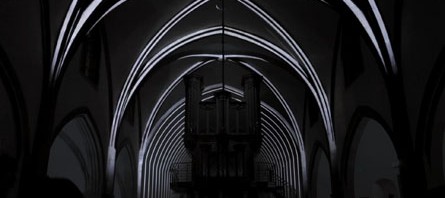
I got hold of Romain Tardy a.k.a. Aalto from AntiVJ and asked him a few questions about their latest mapping project at  Visualiseringscenter C in Norrköping, Sweden.

How much time did you spend on the mapping project in Norrköping and much time was spent working on site / off site?

From the very start of the discussions about this project to its final result, I think it was 3 months. We went to Norrköping to see the place in march, then we spent 2 days on site to do the mapping at the end of April, then we went back home to work on the content for 3 weeks, then back in Norrköping for 4 days to do the final tests and play the piece.
To precise things, I’d say we didn’t have any pre-produced content before we saw the site for the first time. We created everything from scratch, after we saw the place.

Could you break down your process in a few sentences, from idea to the final projection?

It’s always hard to describe precisely the work process, however, the building and its surroundings are always the starting point. We got inspired by the industrial past of the city, and, of course, by the new function of the building: the visualization center. How could we make these two elements meet each other?
We decided that I would be the director on this project, so I started to write a “scenario”, using the notion of labour as the central point of the story, taking both elements of its past (the notion of labour found in the textile industry, also visible in the nearby museum of work) and of its future – a visualization center – also questioning the relationship between intangible and practical work, statistics and factual, labour and its finality, which are all very current questions about our dematerializating world.
As we’re several people to work on the project, I drew a story-board so everyone can refer to the same document. As we work remotely, we meet every 2 days on Skype to see how things going.
Once all the content is done, I worked on the final editing – the actual piece the public sees.

What software do you use while creating and projecting your video mappings?

For this project, Simon Geilfus from our team created a new software so we can use some audio-reactive content based on vector graphics we designed. This software was used in the 1st part of the show. In addition, we used more traditional tools like After Effects, Illustrator, Cinema 4D.

What projectors are you using, how many and what hardware are you using to distribute the video signals to the projectors?

For this project, we used 2 Barco XLM HD30, that are 30K lumens projectors, outputting up to 2K resolution images. We didn’t use 2K resolution, but 1080p FullHD. For playback, we used Dataton’s Watchout hard/software, that is the easiest way to synchronize several projectors and have a smooth playback at such resolution.
The projectors can differ depending on the project. In Norrköping, the projectors were quite far from the building (on the other side of the river) so we needed pretty big ones. For closer projections/smaller buildings, 12 to 20k lumens projectors can be bright enough (also depending on the surroundings, public lights etc.)

Ok, this tech thing is going overboard, but what computers are you using?

Haha, this one’s going too far :D
For production and rendering in After Effects, Illustrator, C4D etc., we use Mac Pro’s (I you really wanna go geek, mine is a 4-core Nehalem with 8go RAM). By the way, Adobe CS5 is a must, working in 64bit on Mac Pro stations – it really improves rendering time and workflow in a general way using the total amount of RAM.
For Simon’s software, a Dual-Core DELL laptop was good enough (geek bonus: a PC running OSX…)

With your setup for video mapping – is it possible to mix content live (VJ-ing) or does everything need to be rendered and synchronized with the music in advance?

With the Watchout system, it’s possible to use live feeds from an external source. To do so, the Watchout must have the optional HD-SDI card installed, so it can take any input.
That said, I’ve never used it, and and I guess it’s a pretty big setup just for VJing. There’s an alpha version of a “mapping” module for Modul8 (made by some French guys as well) that would probably do the job too.

The Pixelache 2010 festival report

April 03, 2010

Pixelache 2010

I was invited to the Pixelache festival to hang out and network. For once I didn’t have to perform or give a speech, so I could indulge fully in the activities. I only went friday to sunday and got straight from the airport in to the Bar Camp session at the Keravan Taidemuseo located in one of Helsinki’s outer suburbs. For those who are not familiar with the term “Bar Camp” I could describe it as a user generated conference where the content is provided by the participants, anyone can post a subject to discuss. This went on the whole day and several interesting discussions went on parallel, so it was pretty hard to pick. I went between groups dealing with guerilla gardening, software presentations, audio visual experiments and open source technologies. The day ended with the opening of two exhibition at the Kerava museum, How to Build a Dishwasher and chmod x+ art and later a Pixelache network dinner in Helsinki.

There were a couple of things from the Bar Camp that I found extra interesting. One is the open source project Puredyne which is a GNU/Linux package for artists. It’s an operating system bundled with a load of open source software for artists and the whole system is bootable from a USB stick or a CD and will run on your Intel machine.

The second thing was the project Brainwave Music Lab where they were making music from alpha and beta brain waves. I’m not going to tell more just watch the video, it give me the chills, you know, in a good way.

YouTube Preview Image

The Saturday started with Breakfast Club III, a breakfast with a discussion about open source technology led by cyber feminist Nathalie Magnan. It got pretty interesting, with many different views. There were the extremists looking for the utopian open source society, there was Li from Shanghai who explained how Open Source was not relevant for young people in China at the moment since people don’t think software costs money and then of course the people complaining that they will become less productive with Open Source applications. For me personally, the more interesting discussion about Open Source technology was on the boat back to the hostel where I came to speak to Italian design students, Emanuele Bonetti and Loredana Bontempi from the Piet Zwart Institute in Rotterdam, who are in a program that runs only on open source software. They said that they couldn’t really find good replacements for the standard design applications but they had other applications that let them do other things and take their designs in new directions. That sounded very appealing to me and we immediately started bouncing more or less realistic ideas.

The Arduino + Fritzing workshop

After lunch there was the Fritzing+Arduino workshop. Arduino is an open source prototyping platform that makes it easy for artists and designer types like you and me to create physical interaction devices. Fritzing is an application that let you document your electronic prototype and help you take it steps closer to production. I’ve been wanting to get in to the Arduino for a few years and this was the perfect time to get started. I bought the neat little starter kit from the Fritzing people that had an Arduino and some basic components.

At night I went to see The Urban Projection Lab, that was an architectural video mapping on the front of the Finnish National Theater. The environment was a little bit to lit up for my taste which made the projections a bit washed out. We actually walked past in without seeing it and had to circle the block. If I understand it correctly we saw a visualization of Helsinki’s energy consumption in form of bubbles going up the facade.

The night continued at IHME Party located at the Vanha Student House. The night started bad with some hipster DJ playing the a Finnish version of a Pippi Longstocking tune and drunken Finnish girls dancing awkwardly. BUT then came the Black Horse + VJ Sakke Soini performance that was AMAZING. It’s rare to see such good band + visuals combination and they got the lighting and smoke to blend in as well. The band and the VJ had never worked together before and it was the band’s first live performance ever. One of those magic moments.

I never got a chance to speak to Sakke Soini that night but emailed him to ask some questions.

(TMT= The Midi Thief/Me, SS=Sakke Soini)

TMT: Your style with, what looks like old optical experiments or maybe just fx part out of old sci-fi movies, is that found footage or have you created it yourself, or some combination in between? And how do you work with your compositions while VJ-ing?

SS: Yeah, they are all my creations. I utilize the same techniques I use for my illustrations. I create clips that are easy mix together a sort of a continuum of each other. Therefore it is really easy for me to mix dynamically during the performances, create dynamic changes quickly and with the music.

TMT: What hardware and software is involved in your creation process as well as the performance?

SS: Mostly I create my graphics with Illustrator and After Effects. During the performance I use Resolume 2.4 running on my Macbook through Bootcamp and a MIDI controller.

TMT: Why are you using Resolume 2.4 in Windows and not Resolume Avenue in OSX?

SS: I tested Avenue a bit when it came out on my white Macbook, but I didn’t see any point upgrading. The program was a disappointment. And why fix something that isn’t broken. But I do very little post-processing during my live show anyways. I mainly just adjusting the colors.

TMT: Your visuals works extremely well together with this music (Black Horse) but what music do you normally VJ to? And how does the look and the tempo of your graphics work then?

SS: I basically have two vjing styles. The one you saw and the other one is more vector based. For the more uptempo i use the vector based stuff. The clubs i normally VJ for is more Electro/Disco/Dubstep oriented.

The second performance of the the night was Swedish Slagsmålsklubben and VJ Motorsaw aka Sune Petersen, an awesome Danish guy that I shared rooms with at the Hostel on Suomelinna. The extremely happy uptempo music of Slagsmålsklubben seemed to work really well with this crowd and so did the visuals. Sune had a project set up in VVVV that he based his whole performance on. It looks like vector lines but is really to slanted rectangles, one masking the other that he can tweak the shit out of with a Korg NanoKontrol. I think that one quality that I particularly liked was the possibility of changing the stroke weight. This might seem trivial but I actually can’t remember seeing it used that much. It’s really useful for interpreting nuances in the music.

The classic after party for those who didn’t want to go home or those who couldn’t get back to Suomelinna took part at a design agency. Slagsmålsklubben, Sune Petersen the Mal Au Pixel crew and others from the Pixelache network. All kinds of alcohol appeared auto-magically when some other alcohol ran out.

Don’t think I really managed to do anything productive the following Sunday. There were a few performances I would have liked to have seen but I missed them and then had to leave for the airport.

An afternoon at Duckunit, Bangkok

August 25, 2009

duckunit_01

I met up with visual artist Wit Pimkanchanapong (33, right) and motion graphics designer Rueangrith Suntisuk (27, left) during a visit to Bangkok to learn more about the Thai media-arts scene. The pair work out of a studio called Duckunit in the Aree district, not far from the Ari skytrain station. I’ve known about Wit since 2005 when I saw a post on the Garagecube forum about an amazing large-scale projection that made me really curious about what was going on in Thailand.

I got in touch with Rueangrith during my research on VJs in Bangkok. He featured in a video of my friend Fredrik Stolpe’s (a.k.a. Cornbeast) performance at the Whiteout Bar earlier this year. I was pretty stoked when I found out that Rueangrith was working together with Wit.

large_multiscreen

Wit’s large-scale projection at the National Stadium Bangkok. See the whole series of pictures from the setup here.

Ductunit is an office for freelance digital artists. Between 5-7 people occupy the space at various times. “I’m not exactly sure how many we are,” Wit says, “we have people coming in from time to time and friends come by to hang out all the time. It’s hard to know who’s considered Duckunit and who’s not.”
The office is a two-story building with a front patio. There are workstations on both levels and the ground floor also holds a big project table and a workshop area. The patio has tables and benches, a bar and a bunch of cool junk lying around, and attracts an amiable stray dog who just comes over to hang out.

office01 office02

The freelancers at Ducktunit usually work independently but twice a year they collaborate. One of these occasions is the yearly FAT Music Festival that Duckunit has been doing together with the FAT Radio station since 2002. Duckunit is in charge of planning, architecture, art direction and production of graphic material from print to video. They also collaborate with filmmaker Apichatpong Weerasethakul and Japanese light designer Jiro Endo.

Wit studied Architecture at Chualalongkong University and has a Master’s degree in Visual Communication from Kent Institute of Art & Design (U.K). Rueangrith has a Bachelor’s degree in Communication Design from Bangkok University where he had Wit as a teacher. Wit later took him under his wing and brought him to Duckunit. Wit has currently taken a break from teaching, however Rueangrith now lectures in New Media at his old university.

“We don’t really do much VJing these days,” the pair confess, “it’s a good way in to the media-arts scene but we’ve now moved on to more complex work with robotics and physical interaction.” Rueangrith used to VJ with a younger crew called B.O.R.E.D. but admits that he now has problems keeping up with the B.O.R.E.D. guys’ party lifestyle. He explains there are about 20-30 VJs in Thailand, but they’re mostly boys straight out of design school. There are a couple of girls out there VJing, but not very frequently.

I wondered about what inspired these guys. Ruangrith claimed that he didn’t really have any role models at all. Wit on the other hand said that he is very inspired by the Japanese company Maywa Denki which is kind of conceptual art in itself. He’s also interested in what’s happening on the Mexican and the Brazilian scene at the moment without dropping any specific names.

I talked with Wit about how they funded their art projects and he told me that they always try to do things in connection with the FAT music festival since they have a high budget and they are up for fun ideas. Sometimes they get commissioned by galleries or art institutions to do projects, or they get money from commercial projects.

YouTube Preview Image

The good thing with Thailand is that everything is cheap; labour hardly costs anything, equipment rental doesn’t cost much and there are no rules about how to build things. However, they can’t get hold of all their equipment in Thailand. They pre-order some technical hardware from friends visiting Japan, and they also order a lot of parts for their installation projects from China through eBay. The quality of these Chinese electronics isn’t that consistent so they always have to get extra units just in case.

Rueangrith’s commercial architectural mapping project for Tiger Beer.

Rueangrith has constructed some small DIY solutions like the simple yet excellent light rig in the Cornbeast video (above) that was made with a budget of only 2000 Bath ($60). One of Rueangrith’s side projects has been building “fixie” bikes, with one gear and no breaks. “It’s just a trend,” he says, claiming that he doesn’t really ride his bike any more. “It isn’t very practical in the Bangkok traffic.” His friend continues to build them and they post regular bike news on their blog – it’s currently the most frequently updated blog in the Duckunit family.

duckfixed_bikes

I’d been looking at Wit and Ruangrith’s work and I noticed a lack of Thai typography. As a person from the western world I find Thai typography exotic and beautiful and I would love to see it used in screen based digital media. Wit tells me that there aren’t that many digital typefaces available for designers, so the options are somewhat limited. Wit doesn’t like using typography in his artwork at all because it gives it a very literal meaning. And as for VJing, he doesn’t think it fits the pace, that Thai type is more of the gentle pace of a brush stroke or a calligraphy pen. Wit says that his teachers tried to push Thai typography really hard and consequently he’s is in denial. He reveals that he reaches “Thainess” not so much through visual representation but rather with the use of concepts, pace and “flexible ways of working”. By the latter he refers to the way he is able to use cheap labor, no rules, inexpensive materials and rentals, among other things.

Before leaving I wanted to check what equipment and software they were using. Computer-wise there seemed to be mostly Macs around the studio. However, I did see a little PC laptop standing somewhere and I’ve seen PC software being used in at least one of their videos. Wit says they’ve been using the Modul8 software for VJing and large screen projections. For installations, like the kinetic Ma-ya-rab project, he used the Arduino micro controller together with Processing and Open Frameworks. Rueangrith is also working with Apple’s Quartz Composer. They had a Korg MicroKONTROL lying around somewhere for whenever they need to control something with MIDI. Wit has a programmer friend that helps out with some of the more complex object oriented programming and he gets paid with massages (not by the Duckunit crew but by professionals), the kind with a happy ending! I guess this also plays into the “flexible way of working” in some respect…

As Rueangrith is driving me back to the Skytrain station he says, “You know when you asked me if I had any role models and I didn’t say anything? I didn’t want to say it in front of him but Wit is my role model. He pretty much founded the media-arts scene here in Thailand at the beginning of the Millennium.

More links:

The Duckunit blog
Wit’s blog
Wit on Vimeo
Rueangrith on Vimeo