Siggraph Asia

[youtube]http://www.youtube.com/watch?v=53UBwizC7pY[/youtube]

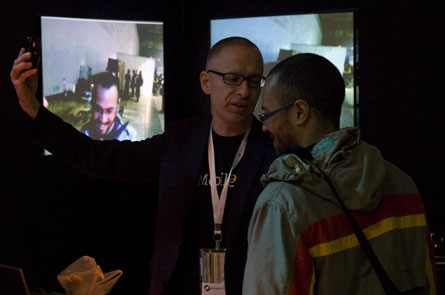
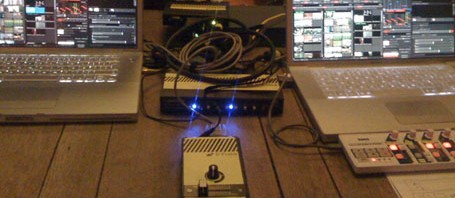
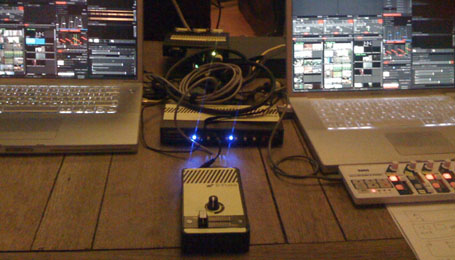
I just got back from Siggraph Asia in Yokohama, Japan. Siggraph is an expo for the world’s leading experts on computer graphics and interactive techniques. I was helping Mobile Life giving a demo of the Instant Broadcasting System that they were showcasing in the Emerging Technologies section. I didn’t really have much free time to see the rest of Siggraph but visited the art exhibition and I met a few fellow VJs.

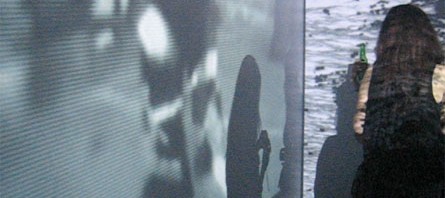
In the art exhibition there were a couple of things that stood out. The tree panel projection by Tokyo Wonder called Lights & Shadows (top video) was truly beautiful and well made.

The most exciting pice however was the Lumarca, a 3d volumetric projection on to strings. It’s made with Processing and the code is open source and downloadable through Google Code.

The VJs I met were Stuart J H Ward, a Canadian expat who has been living in Tokyo for few years and who’s very involved in the tokyo VJ scene. Stuart says the japanese VJ scene is pretty behind technically since many of them are using Motion Dive Tokyo and are bound of the limitations of that software.  Then I ran into Nicolas Guyon who is one of the two creators of a VJ application called AWI, Audio Wave Interaction. The last VJ I met Tu from Bangkok based B.O.R.E.D., a VJ crew who I mentioned earlier this year in my Duckunit article. I never met Tu before since he was in NYC studying at Parsons when I was in Bangkok interviewing his friends. Tu had a his short film “A film from underneath” showing at Siggraph.

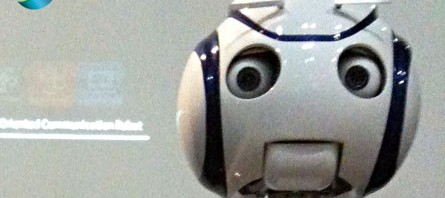
The rest of my Siggraph experience contained corny robots, an interactive sun rose and some pretty interesting physical computing gear from Microsoft Research in Cambridge which was kind of like the Arduino but without the soldering. And of course all the variations on touch screen and depth perception equipment that you can imagine (yawn!).

All eyes on: Leolyxxx

I’ve been mailing back and forth with my buddy Leo Hallin a.k.a. Leolyxxx during 2009. Leo is a talented illustrator who recently transfered in to the animation scene. He has done some remarkable animations together with fellow artist Finsta. Their animation “Bollen” has reached +15k hits on Vimeo. Leo has talked to me about using his animations for live visuals and he recently took one step closer by making this really nice loop for O-Baren, a popular Stockholm bar.

Even though he has a simple style, he has to work hard to create many clips. The way he makes them he could easily transcend from one clip to another with his own animated transition effects. His figure-ground work is also amazing. I’d love to see leo taking the plunge and mixing his animations live in 2010!

Check out Leo’s homepage.

Instant Broadcasting System

oskar-demo

Instant Broadcasting System is a software solution for receiving and mixing several video streams from cellphone cameras and broadcasting it live on a screen and/or to the internet. It’s an academic research project from Mobile Life in Stockholm under the lead of Ph.D student Arvid Engström. This project has been going on for about two years and I’ve been helping out on and off during these two years. The software has gone through a few name changes during the project. I’ve written about it here before under the names WeJ and Swarmcam.

The solution has two components – a Symbian application that is running on a Nokia N60 cellphone and a Max/MSP mixer application that is running on Mac Pro. During this demo we’ve been using 3 cellphones but the system can for sure do 8, probably up to 15. Each input takes a lot of CPU to process so you need a powerful computer to do it. The program has been tested on a MacBook Pro but it hits the ceiling pretty fast. And another problem with having many inputs is that it’s hard to overview all the preview windows. The cellphones streams the video over wifi or 3G to the computer. The resolution of the video is 320×240 at a top frame rate of 15fps. This isn’t very exciting but with Turbo 3G already here (in Sweden at least) and 4G at the doorstep we can expect much better image quality. Some new phones have a better codec for video compression which also gives better video quality. The software on the phones will be able to run on other Symbian enabled phones as well as the Androids. The iPhone has had it’s video functionality under lock, but since the recent release of the Bambuser app it seems like it would be possible to cover the iPhone too.

ibs-interface

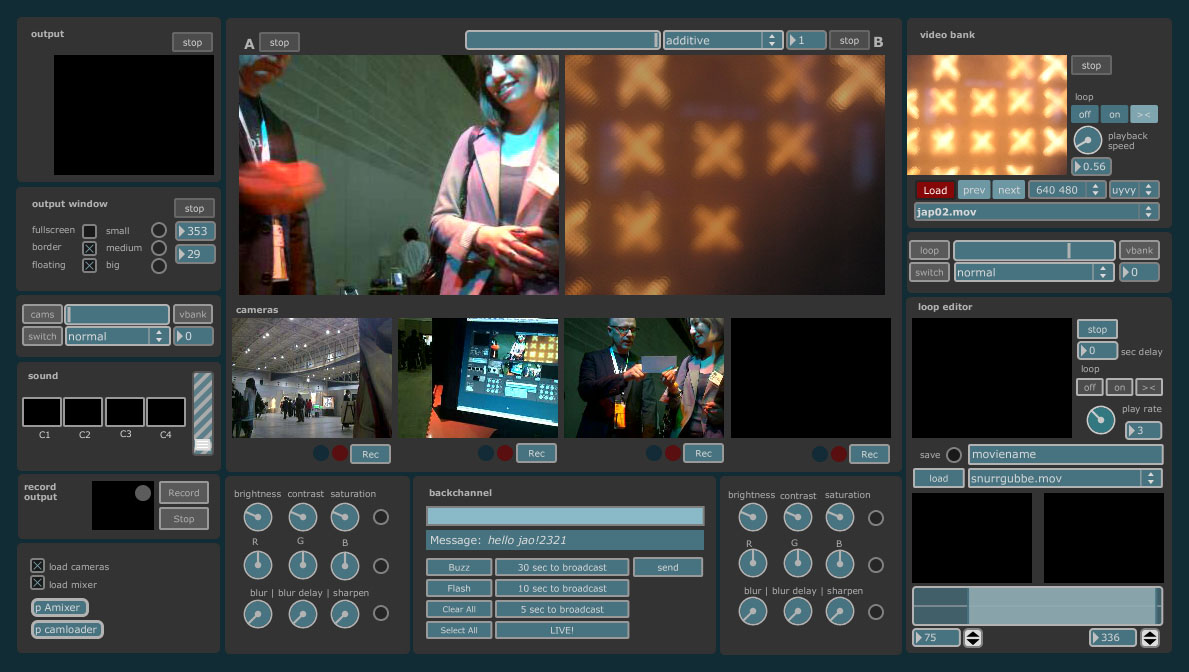
The interface has gone over a huge overhaul and finally got some design to it. A quick run trough:

In the left column you have a preview window and output settings as well as audio settings, you can broadcast audio from one phone a the time.

The middle column is the home of the A and the B unit as well as the preview windows for each camera. You can see four preview windows but we were only using tree for this demo. Below are the image settings for the A and the B bus as well as a the “Backchannel” which is a system for communicating with each camera person. The A unit of the mixer hosts the cellphone camera streams. You switch stream with the number keys or by clicking the preview windows. The B side hosts the more artistic side; pre made clips from the video bank and loops (recorded from the live streams). You can crossfade between the A & B as well as mix them through blend modes.

The right column has the video bank on top and the loop module underneath. You can feature either the loop module or the video bank as well as mix them together with blend modes. A nice thing with the loop module is that it has a recording buffer. This means that when you hit rec, it actually starts the recording back in time making sure you don’t miss the action. The in and the out point of the loop can be adjusted and you can save the loops for later use.

The interface could be controlled by a midi controller. We have had the Novation Nocturn mapped for this demo.

So would I use this software for VJ-ing? No, not at the moment. It sure is an interesting technology but over wifi and 3G, the image quality just isn’t quite there yet. I am however very curious to see if Arvid will add more VJ features like beat matching and on-the-fly midi mapping.

Yokohama: Best in show

[youtube]http://www.youtube.com/watch?v=ZmOxdFZzAvI&feature[/youtube]

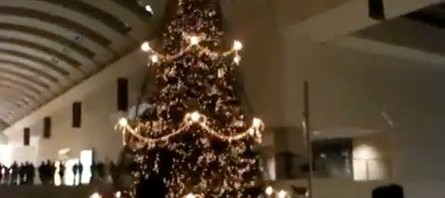
I’m in Yokohama for Siggraph Asia. I’m helping out with a demo of Instant Broadcasting System, a software for live mixing of videostreams from mobile cameras. We’re in the Emerging Technologies section, if any one is stopping by. I will write more about the software later but first I thought I’d share this Christmas tree from Queen’s Square, Yokohama. Our boss, Oskar, voted it best in show (a bit premature since Siggraph hasn’t started yet and the tree is not part of the exhibition in any way).

Mapping Festival 2010

mapping2010-logo

From May 6th through the 16th 2010, the Mapping Festival will take place in Geneva, Switzerland, in differents venues: Bâtiment d’art contemporain (installations and AV performances), Théâtre du Grütli and Théâtre de la Parfumerie (workshops, AV performances and live performing acts), Zoo & Spoutnik / Usine (AV performances and VJing) and Uptown Geneva (professional space).

You have many ideas and projects, the call for entries is now open, so we are counting on you to be there and spice up the Mapping Festival menu!

This year again, the festival will promote the mix of disciplines, and you will be able to apply for the following categories:

  • VJing
  • Audiovisual set
  • Installation
  • Outdoor projection
  • Lecture / Workshop / Presentation / Demo

This year, the application is on line on our web site: www.mappingfestival.com
Beware, the delays to apply are short: you can apply until January 4th 2010.

If you want to present your products and/or activities (hardware, software, collective, agency, company etc…) in our space dedicated to VJing professionals, don’t hesitate to contact us.
For more information: pro@mappingfestival.com

Installation group effort

This installation at Heineken’s Green Room Sessions party at Malmen, Stockholm, is a was a group effort. Jakob Grandin, head of Grandins Flying Circus asked the Vidiots to set up a triple screen video installation displaying film and photography from a number of artists. One wall displayed a slideshow and the other two video. Every 8th second a strobe went off the movies and the slideshow changed.

The gear used in this project was 3 projectors, a Triplehead2go and a Macbook Pro running Modul8 (VJ software). A Modul8 module, that was programmed specially for the occasion by The Midi Thief, sent a midi signal to a DMX light board causing the strobe to flash and the video plus slideshow to forward to the next piece.

Contributing artists:
Curator – Tony Cederteg
Left wall – Ruben Broman
Middle wall – Mathias Sterner
Right wall – Nakkna

Fresh out of Gothenburg

Startsladd has busted out a new hot and fresh VJ reel. This crew is a about video and custom content. They usually make all fresh content for each show and record video the day before and on the same day as the event featuring the city, the venue (where ever they happen to be) and the artists as well as live video and stills from the event as it goes on. More on Startsladd here and be sure to check their new web site as well.

More on the *Spark + dFuse mixer

spark-dvimixer-short

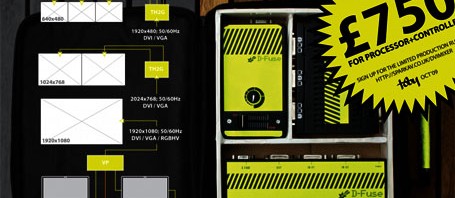
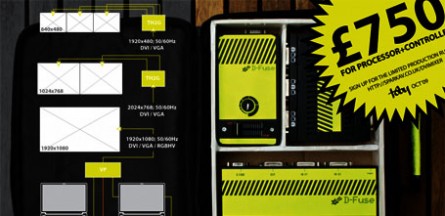
All work and no play makes Mikey a dull boy. I’ve been busy with work and not been able to post for a while. Got some half finished articles just waiting to make their way on to the blog. But some news just magically produce themselves. Like this one: The *Spark Defuser mixer by Toby Harris is one step closer to getting into production. And you can help by showing your interest so that Toby can esitmate the price better and get to the next step. Read all about it here!

To be a little bit more objective about it than in my last post: This is not an entirely new subject and it has been talked about before. That’s why some VJs wern’t too excited when they heared of Toby’s project. Read more about it in this recent thread and this old thread on VJ Forums.

But still, considering the decent price and all the features I say I’d probably buy the mixer.

The *spark + d-fuse mixer

tobyz_box

Sometimes prayers are heard. Remember the poll we did where we were asking “What do you think is a reasonable price for a modern video mixer that has the ability to mix VGA and send out an video that spans over 2 or more screens?”. A saint named Toby Harris has modified a conference kit and built a controller for it so that it’s possible to mix two VGA or DVI sources and output to a Matrox TripleHead2Go, which means that you can make a multiscreen projection and mix content from two computers. This has been possible to do earlier, but at a huge cost. Toby is negotiating with the manufacturer of the original box and he is planning to assemble enough orders to put it into production. His estimated price for the box is… ta-da… somewhere in the $1000-£1000 range. At the moment the manufacturer is busy with a trade show. We just have to tap our fingers impatiently until deal is sealed and Toby is ready for pre orders. Read more about the mixer on Toby’s website.

Results from the poll:

[poll id=”8″]

Modul8 2.6 Beta

modul8_26_beta

So finally, the long awaited Modul8 version 2.6 is now out in beta. Along with some bug fixes and Snow Leopard compatibility there are some exciting new features: blend modes, sound analysis, dmx support, 4 video inputs and importing/exporting of midi & key maps.

The beta is available for registered users and the final version will be charged a €49 upgrade fee. Garagecube hasn’t charged for minor versions before and even if annoys me a little bit, I’d still buy the update in a heart beat. Even if I’m missing better OSC and Quartz Composer support in this release, this is a huge step in the right direction.

Read more about the new version at modul8.users.