Dave Lublin, Vade and Bangnoise – The Big Interview

David Lublin, Vade, Bangnoise

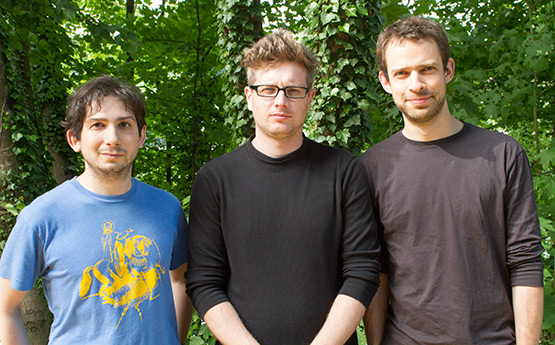
When I visited the Mapping Festival I had the opportunity to sit down with Tom Butterworth (Bangnoise), Anton Marini (Vade) and David Lublin (Vidvox/VDMX). These guys’ presence was actually my main reason for going to the festival.

Anton and David live in NYC and see each other fairly often. Tom lives in Scotland and this is actually the third time the three of them have met in person. When I ask how they first met, the guys laugh when they realized it was through bug reports. Through the reports they gained appreciation for each other’s coding skills and ended up collaborating.

Many of us are familiar with the trio’s work, but for those who are not: Tom and Anton are the fathers of Syphon, a technology for sharing video in realtime between apps on Macs, as well as the v002 plugins for Quartz Composer. David works at Vidvox with the VJ software VDMX, and Tom and Vidvox made the Hap video codec that now works on both OS X and Windows, as well as several other plugins, apps and frameworks that they’ve shared with the public as open source over the years.

The trio communicates through instant messaging, email and GitHub comments. They have tried Skype a couple of times but they say they don’t really feel the need for seeing and hearing each other.

Syphon

Is the traditional hardware video mixer now redundant? Are people already mixing from computer to computer over the network?

Tom: There are a few solutions for Syphon over network. There are a few different Max patches and a couple of apps. None of them are ideal for large frames and latency is sometimes a problem. I’ve tried my own solution and it isn’t as good as it needs to be.

Anton: Gigabit ethernet is not really fast enough to pass an uncompressed HD frame. We’ve thought long and hard about how we could possibly do this. With Thunderbolt 2 there is more bandwidth but still only 10 gig allocated for the network.

Tom: We continue thinking about this.

I always thought that there was a max size to the Syphon texture, but I heard that’s wrong: it’s decided by the graphics card?

David: The application generating the texture may have a limit.

Tom: Yes, but the limit of Syphon is your graphic cards’s texture dimension limit.

Anton: It’s 8k or 16k per texture.

David: It’s more than you are actually going to be able to do.

Tom: The program you’re using is probably unable to render a canvas that size, but Syphon is ready for it.

Are you still developing Syphon?

Tom: Yes, our near term to-dos are OpenGL 3 & 4 support.
One thing we don’t have is a presence in Apple’s App Store but that one is going to be a pain. Apple don’t like one app talking to another app for security reasons.

Anton: Float texture support. Right now Syphon really only deals with 8 bit per channel textures and we want to support something with higher bit-depth to get higher fidelity. A use case for that would be Kinect depth maps. If you have an image that is 32 or 16 bit floating point and you want to transmit it to another app it clips and you will loose depth of precision.

All of these are totally solvable. It’s just about finding the time to do it, and making sure vendors update their Syphon version, and figuring out the fallback if apps are using different Syphon versions.

What about the Syphon-like attempts on Windows?

Tom: We’re interested to see where those things go. Wyphon was a bit of a focused solution to a single project. Spout seems to have more of an idea about what they are doing but it’s certainly a very young project.

Anton: We’re really glad they took their time to do it.

Is Syphon to Spout something we could see in the future?

Tom: We have discussed that a little bit with them and it would be good to continue that discussion.

Anton: It’s contingent on that bandwidth over network thing we talked about earlier.

What about Syphon for Unreal?

Anton: It’s totally doable. If it uses OpenGL and has a plug-in system it should be possible. But I haven’t asked anybody to make it. If there’s a need, somebody will make it.

David: I think someone makes a script that you can run and tell any OpenGL enabled program to insert a Syphon server into it.

Anton: Oh, Mach Inject. It’s a technology where you have to have root user privileges. You launch your program and it overrides the system calls and inserts a Syphon server into any application that uses OpenGL. Supposedly it works but I’m a little paranoid about it. It’s not the ideal solution but a beautiful hack.

If you want to use Syphon to broadcast a video stream – are there any good solutions?

Tom: CamTwist is one way to do it, it’s the normal solution. (CamTwist is a free app that turns the input into a camera feed that video streaming solutions like Bambuser and Ustream can use).

Anton: Jitter has a way to talk to IP cameras and RTSP streams so you can do that with Max MSP Jitter and go straight to a Syphon server.

Tom: I have an app I wrote for connecting a Canon camera to Syphon and someone contacted me on Twitter the other day and wanted some help with that – it was a webcam girl, she wanted the best possible image for her business.

Speaking of that, what is the weirdest Syphon workflow you’ve seen so far?

Tom: Our favorite at the moment is Alejandro Crawford who is touring with MGMT. He flies a quad copter over the crowd with a camera attached. That comes into VDMX and then goes over Syphon to Jitter and then into Unity and gets mapped onto objects and then that goes back into VDMX and creates a feedback loop – and it also goes out to Syphon Recorder.

Quartz Composer

There has been a lot of talk about the life and death of Quartz Composer. Has the popularity of Origami brought new life into Quartz Composer?

Tom:No, it’s a dying gasp.

Anton: From what I understand from talking to people at Apple, there is only one person who is on triage on quartz composer. They don’t have active developers, they’re only doing bug reports and very rare fixes. Everybody on the Quartz Composer team that was doing active development has been moved either to Core Graphics or OpenGL. Just because Facebook uses QC for prototyping, Apple doesn’t give a shit.

Math & programming

People tend to think that you need to be good at math to get into programming. Are you guys good at math?

Tom: I studied philosophy and literature and I’m very bad at math. I have to read, write down, check, double check, quadruple check and then send it to someone else who tells me it doesn’t work.

David: I studied math in high school and college. I can figure things out but I’m always slamming my head against the wall and double and quadruple checking myself. But when I do have to do it, it’s kind of a pleasure getting into the rhythm.

Anton: When I stared out I was really, really bad at math. I think programming and working with live visuals and understanding how to make things has demystified a lot of it. It has exposed some common techniques that makes me understand and appreciate math. GLSL has given me a better understanding of linear algebra since I had to snatch my head around it a million times.

Anton and David agrees that they would have spent way more attention to math in school if they would have had interesting examples, like GLSL shaders, to apply it to.

David Lublin

The new plugin system, ISF, that you recently introduced in VDMX, was that created because Quartz Composer is singing it’s last verse and the problems with Core Image’s memory leaks?

It was something that people have been asking about for a long time but the problem with QC and Core Image made us push it further up on our agenda.

Now when it’s picking up and people are starting to really use the effects we are going to make a web site for people to share them. Someone has made an OpenFrameworks add-on so you can use them in oF too. That will help it to make it more of a standard.

We have made ISF versions of all our Core Image based plug-ins plus we added a few other ones.

VDMX ISF plugin

Have you made any tutorials for how to make ISF plugins yet?

There are two tutorials but they are very introductory.

Have you thought about integrating Processing with VDMX?

I didn’t think it was easily possible. If we had somebody who knew Processing very well, we would be really interested in supporting Processing natively. We want to support as much stuff as we can. In fact, one of the discussions we’ve been having is how people doing Open Frameworks development can make their stuff into a plugin without jumping through too many hoops.

How about loading 3D models straight in to VDMX?

Several people has asked me about it. 3D is not something we have done a lot of in the past so we’re trying to beef up our knowledge. Anybody who wants to work with 3D models in VDMX should send us emails saying how they think it should work.

One of the problems we’re dealing with is that VDMX uses an orthographic projection because it’s just video. But when you’re dealing with a 3D object you deal with different kinds of perspectives in OpenGL so we don’t know if we need to let people set that for what they are working on or if Orthographic is fine, since we’re going to video anyway eventually.

And now when we have ISF plugins, we have the ability to write vertex shaders. Should we make it so that as part of the video source, you apply a vertex shader? How do we introduce effects at that point? Do we have 3D effects? What happens if we apply a 3D effect on a 2D layer? If you have a 3D layer, how should that work with other 3D layers? Do we rasterize it to 2D or do we let a 3D object travel around? That would mean a huge change to the rendering engine.

Edge blending – is that something that should be in the app?

Yes, it’s something we have talked about and it might happen. We have talked about it in relation to if we should add more mapping features, but there are so many projection mapping tools out there already. Edge blending is a special case that we might want to do anyway.

How about Vuo support? I’ve heard from the Vuo team that they are working with some of the VJ app vendors to make it possible to use Vuo in a similar way as Quartz Composer is used today.

They have development they need to do. And VDMX is currently still stuck in 32 bit mode while AVFoundation is getting it’s stuff sorted out. If it comes together we will be happy to support it.

Anything else new in VDMX?

Over the last few months we have slowed down on our feature releases because we have been revising a lot of our code so that we can make the code more reusable and make large-sweeping changes throughout the app. It’s nice to have some time to improve the code and make the backend better even though the users doesn’t see it and appreciate it that much.

But yes, we have added a bunch of new effects and HID (game controller inputs) for the next release.

Name some artists that has inspired you

The Cycling 74 people were a huge inspiration, Max MSP made me love coding visual stuff.

The Light Surgeons

Bill Etra

I grew up with MTV, so Chris CunninghamSpike Jonze and Michel Gondry.

Tom Butterworth

How do you describe your job?

Programming for video, video for performance ideally.

So living the the dream?

Maybe, sort of, trying to make the dream realizable.

What’s the dirty work you need to do to make it realizable?

Less interesting programming. It’s still to do with video but some of it is less fun.

I am quite lucky that I sometimes do get paid to work on open source projects which I really enjoy. Vidvox in particular are really good about supporting open source.

How about crowd funding? I know you know you tried it for the dance project “Fiend”.

I’m not a fan of crowd funding for arts projects. It’s basically begging from your friends. We had Arts Council funding from the U.K. government and it was a way to supplement that. We just asked for a very small amount.

I’ve seen other people fail with crowd funding of software

That’s different, that kind of crowd funding might work because in the end the backers get a product. I don’t think it’s the ideal way to fund software development, I’d rather just get paid to do it.

Could there be some kind of app store economy to it where you can pay a small sum and receive an app?

I don’t think that’s interesting. For a lot of things it’s important they’re open source. Nobody benefits if people have to remake basic tools all the time. It’s much more interesting if you can just say: here’s a tool that is useful and then everybody could just use that and move on together and think of what the next development is to make it better. Things like Syphon and the Hap codec, their success depends on their take-up.

We get some generous donations from companies using Syphon and Hap but we don’t really get donations from individuals – though there are some exceptions that we are really grateful for.
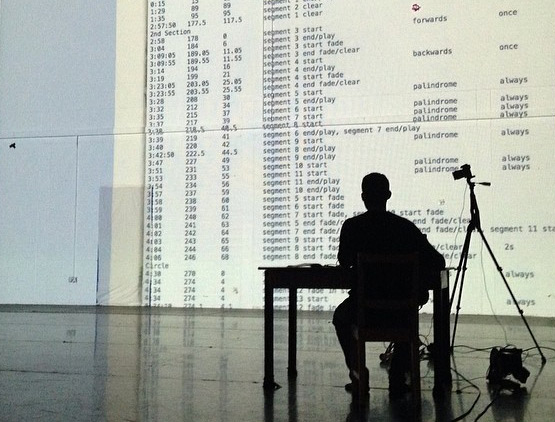
Photo by Tim Casson
Photo by Tim Casson

How did the Fiend project go?

We have only performed it once but we got really good feedback. We have a couple more dates coming up. It has been really fun to do and it has been totally new for me – I normally sit at my desk and write code and send it to someone a few weeks later. So it’s quite different to sit with a dancer in a studio who wants you to make a change in 10 seconds. In the piece, I have a table and chair on the stage with my back to the audience. I manipulate all the video live. I think that is as close to being a performer as I will ever get.

Now a user question: Will the Datamosh plugin for Quartz Composer ever be updated to do full HD?

It does full HD. I guess the user’s computer is not fast enough. I’ve used it in 1080 and I’ve rendered out huge canvases in Quartz Crystal, even if that’s not quite the same. But yes, I should upgrade it. It would be good to try a version with 64-bit support using AVFoundation.

And the Video Delay plugin – if you want to use it live to create a slit scan effect, is there a way to make it respond faster?

I used it for a section in my latest dance piece. While developing I had a 2010 Macbook Pro and just before we did our first performance I got a new laptop and that made a lot of difference. So once again, buy a faster computer.

The plugin is limited because you can change the delay map while running the composition, so it has to save every full frame of video to create the delay. All of that happens in main memory because it is too much to keep on the GPU, so then I have to assemble each frame on the CPU and that’s a laborious process.

If you want to use it for slit scan, try the ISF plugin David did for VDMX. Because the map is never going to change it doesn’t need to store every frame, so it’s a very fast operation.

Name some artists that has inspired you.

Toby (Spark) Harris’ nonlinear cinema

Stan Brackhage’s silent hand painted films.

Rick Silva

Gertrude Stein

Rosa Menkman

Anton Marini

Where do you work?

Right now I’m a software developer for a startup called Ultravisual, I do that full time. It’s a multimedia social network. Video, Photos, Instagram-like filters, editing and stop motion. You can curate content with multiple people together. So you and I could for instance have a Swedish VJ Union jam where we could both could put images and video and repost, remix, that sort of stuff.

v002

Tell us about v002, your performance app

It’s been a hobby, something I’ve been working on a lot. It started as an open source project, as a very simple tool. But it ended up very cluttered because I built it very quickly and it didn’t have a good philosophy behind it. Then I did a residency at Eyebeam and redesigned quite a bit of the app and it became node-based and elegant.

Tom has been really helpful with it, he has been doing a lot of work implementing it. My role is that I work on the design pipeline and interface ideas. When Tom and I met in New York, he was staying with me and we spent a few days talking about this app and how we wanted it to work and different ideas we had for it.

What I would ideally like to do is to walk into a show with nothing prepared. Imagine: It’s like you’re a musician and you just improvise, so you would need to be able to play the software like an instrument. And what that doesn’t mean is that you have a preconfigured setup. It means that you’re able to make an entire composition in realtime and perform it live.

So everything about the application is about eliminating the latency between when you want to do something and when it gets done. I get very frustrated at times with certain tools where you have to do so much work ahead of time to set it up and to me that defeats the whole concept of realtime. If I have to do everything beforehand and then I hit a button and it plays it and then I hit a button that automates it, then why not make a movie and play a movie? If it’s realtime – then let’s make it fucking realtime!

So the idea is that the entire spectrum of the way the software is designed, from the interface to performing, is improvisational. Meaning the whole thing is an instrument that is meant to be elegant and simple and that means that you need to remove a lot of stuff. You start with a blank canvas: when you create a movie player, you get a movie player with the interface hidden. If you want the movie player interface, you can bring it out. You can record gestures into the interface and when you stop recording, it plays it back. The idea is that you can modulate and effect your performance. You can slow things down, you can speed it up and you could quantize. But you don’t quantize the image, you’re quantizing the performance. It allows you to very quickly move from one mood to another. It’s about being very flexible and very improvisational, that’s the goal of the app. The whole thing is a design experiment, it’s not meant to replace VDMX or Modul8, but what I think it would do is to swing the pendulum far in the other direction.

The app is supposed to be out but it never got finished. I don’t know if I ever will release it. But if I do it will be open source, that’s the only thing that makes sense.

People who follow you in social media can hear you moan a lot over OS X – what’s stopping you from switching to Linux?

Because it’s even more of a pain in the ass! I just spent a bunch of time trying to develop some stuff on the Raspberry Pi and I have never been so frustrated in my life. When I updated the Raspbian operating system, it installed the experimental version of the OpenGL driver on it’s own, and suddenly my application ran at half the frame rate.

Wasn’t there a flag you could set in the installation command?

No. I spoke to the people responsible and they said “yeah, we probably shouldn’t have done that”. So it’s because it’s a bunch of people that are hacking on it, I understand it.

Honestly, I’ve been thinking of going to Windows. Because there’s really great apps on Windows like TouchDesigner that I’m really interested in – it looks phenomenal. And a lot of my friends are using it and they are making really good work with it. It’s very similar to Max MSP, I love Max, and Apple is clearly focussing on iOS. They’re making iPhones and that’s all they care about – fuck ‘em.

If you could sum up all your OSX frustration in one word – what would it be?

“Seriously?!”

Name some artists that has inspired you.

Memo Atken, he is amazing. I like the work that he does and his general philosophy and that he shares his work.

Jasch, a Max MSP user who makes phenomenal generative stuff. That’s the stuff I was chasing, I wanted to get to that level.

Chris Cunningham

Steina and Woody Vasulka

Summing it all up

After tracking these guys on-line for years, it was great to finally meet them.

Tom is one of the most humble people I’ve ever met. He is not even bothered when other people get credit for things he has done. I never thought about that fact that Tom hasn’t been a performer until his recent “Fiend” piece. Before that he has just been solving problems for other people.

Anton is way more nuanced and verbal than you might expect from following his social media feed. Even if he curses Apple on a daily basis he knows that the VJ scene is such a marginal target group that all the defects that we suffer from will probably never get fixed.

David is an intense guy that seems to be always on. He was in workshop mode the entire festival. Whenever someone had a question a laptop magically appeared and suddenly you saw a group of people huddling over the screen and you heard him explaining advanced VDMX concept but making it sound as easy as iMovie.

I will probably never be able sit down with all three again but I hope to catch them all individually in a nonlinear future.


Read the report from the 2014 edition of the Mapping festival.

Mapping Festival 2014 report

ms.showjockey

It took 10 years for me to get to the Mapping Festival in Geneva. I wish I would have gone sooner but being there for the 10th anniversary was great. People who has been coming for years said that this year was one of the best in the festival history. I missed the beginning of the festival due to work and arrived by the end of the week, right in time for the wrap up of the LED fashion workshop. I met up with my Swedish buddy Patrik Johansson (Current Current) who was attending the workshop and he introduced me to people. The class had spent four days learning how to solder and control wearable LEDs.

The final fashion show was really something special. A few professional models mixed with people from the workshop walking their own creations. All the lights were in synch with the music and were being controlled by one central computer.

Video installations

While picking up my badge at the festival head quarters I took a look at four really neat video installations in the gallery space. My favorite was Benjamin Muzzin’s “Full Turn”. It’s really cool “what the fuck moment “ to enter the room while the piece is running. You see holographic looking 3D shapes floating mid air. You walk around it and slowly start to get an idea of how it’s made. You still want to stick a finger in there to make it stop to examine it closer.

After a few minutes it stops and you get some piece of mind (and you’re pretty glad you didn’t stick the finger in there).

The VJ contest

The Mapping Festival’s VJ contest is world famous. For those of you who have never experienced the contest in any form – here is a short break down on how it works:

In the first round the VJs bring their own soundtracks and showcase their own style of VJing. For the second round there are eight contestants left and each one gets to pick a random music style. After each round the jury comments on the performance, giving good advice as staying away from mirrors, tunnels and warn about heavy use of stock effects. The final four gets graphic elements from the jury that they have to use in the next round. The contest continues the following day with the semifinals.

Finally there are two VJs left that gets to battle it out back to back starting with 6 minutes each then 5, 4, 3, 2, 1. Then the winner is announced and gets spoiled with hardware and software prices.

VJ Eletroiman (Ricardo Calado, BR) and Chindogu (Marcelo Vidal, UY) made it to the final round this year. Eletroiman kept on a theme that he has been following for years. It consists of a dreamy world containing his own made up brazilian tribal characters which are represented and animated in a few different styles.

Chindogu sported a graphic style with a variety of patterns but had some technical problems in the first round. Both contestants interpreted the music into graphics very well, almost uncanny at times. After the final minute, VJ Eletroiman came out as the winner and received so much gear that he must have had trouble checking in at the airport.

Worth mentioning is also that the VJ contest at the Live Performers Meeting (LPM) in Eindhoven just went down and guess who the finalists were? Eletroiman and Chindogu – but this time the table had turned and Chindogu came out as the winner.

A/V performances

I watched a few of the A/V performances at the Galpon Theatre. The one that stood out to me the most was the French duo Nonotak (Takami Nakamoto, sound & Noemi Shipfer, visuals).

The performances were all great but I think 40 minutes is too long for a sitting audience. I think all performances could have been 20-30 minutes. It’s not enough variation in music and visuals to be that long. Or let people dance and enjoy it their own way. And I don’t mean this as disrespect to the artists, I’m purely seeing it out of an audience perspective. It felt long even for someone like me who understand and enjoys this art form.

The New York Mappathon show

The NY Mappathon was a three day workshop curated by New York artist CHiKA in collaboration with Anton Marini (Vade), Tom Butterworth (Bangnoise) and Dave Lublin (Vidvox/VDMX). The workshop ended with a show at the Galpon theatre. The students had decorated the exhibition space with boxes, spheres, pyramids, mannequins and skeletons. Some were also using the the fixed interiors. A couple of pieces were interactive; one had a face turning towards the viewer using blob tracking. In another piece the students let the viewer control the mapping with an iPad.

Great conversations

There were so much to see at the festival but I also made sure to take my time chatting with artists and developers. One of the big trends in mapping software right now is automatic edge blending. We will see it in the next version of MadMapper that will come out in a few months. By the end of the year we will also expect to see this in Blendy Dome.

I’ve been speculating for a while that Garagecube is working on a new piece of video performance software. There has been little pieces of evidence here and there over the last two years. I got this confirmed now but it will take a while for it to see the light of day. It’s supposed to be built on same framework as MadMapper. The software does not have a graphic user interface yet. Rumors has that the software ran one of the installations at the LED fashion show.

I assume this is why there hasn’t been much progress with Modul8. But there will be one surprising feature coming up in Modul8 later this year. I won’t reveal what but it’s something the users has been asking for a lot.

I had a really good conversation with Lise Couchet. She was telling me about shutters for projectors for going complete dark when not projecting any content to get rid of the “almost black” projector frame. These techniques are often used in theaters but not used enough for video performances. Tom Butterworth later told me a story about how one theater used the tray of an old DVD player to cover the lens. The improvised shutter was conveniently controlled with the DVD remote.

VJ Lupin, Andy Teasdale and me.
VJ Lupin, Andy Teasdale and yours truly, The Midi Thief.

Two of my favorite characters at the festival were the Modul8 module expert Andrew Teasdale (the Gener8 module suite) and the Wavesum founder Teemu Karjalainen (Waveclock and Wavetick). I think we might see some collaborations from these two geniuses in the near future.

I must not forget to mention Gael Abegg Gauthey (VJ Lupin), Garagecube’s community man who took over after Ilan Katin. Not only a great guy and python teacher, he is quite a comedian too.

I had a good talk over dinner with the Blendy Dome guys, Pedro Zaz and Roger Sondré. They are working the dome scene from and underdog perspective with a very good result. Roger showed me a couple of side projects. One is an audio reactive mesh software for OSX and iOS called Pul.se and the other one an addictive mobile game called Bananas that will be released soon.

Club Le Zoo

I finished my weekend in Geneva with a big night at Le Zoo. They set designers had gone all out with screens. The big room was covered with numerous scrims and a video mapped festival logo behind the DJ.

When I entered the venue, Vade and Dave Lublin (as “White Morpheus”) were performing together. Good to see two of my favorite developers knocking out a VJ set. Vade was sporting a good mix of geometric and glitchy clips while David got stuck with an animated graph for a while also taking care of some crash reports mid set. Heleen Blanken (NL) followed with some nice video shots but wasn’t that in touch with the music. The big VJ act of the evening was the classic German act Pfadfanderei.

The guys performed a terrific set. They were not using a lot of media, they pretty much kept with one scene per song but doing cuts and effects within the scene. I kind of like this approach myself, maybe it’s something that comes with age?

I left Le Zoo shortly after 5 in the morning to catch 3 hours sleep before heading to the airport. I might as well have stayed out longer, those tree hours did’t help much. The flight home will not go down as the most pleasant in history. Cold sweating while trying to process all the impressions from my four days at the festival. I will be back, that’s for sure.

Next up: An interview with Anton Marini (Vade), Tom Butterworth (Bangnoise) and Dave Lublin (Vidvox/VDMX)  – the brilliant people behind the things we take for granted these days; Syphon and the HAP codec.

VJs for charity

Musikhjälpen


Come and bet a few bucks on VIDIOT’S VIDEO SLOT MACHINE on Saturday at Vinterträdgården. You can win a membership card at Stockholm’s best place, Trädgården! (Three cards if you’re really lucky).

And there’s of course a whole bunch of bands playing.

All revenue goes to Musikhjälpen (The Music Help).

A big thank’s to Mikael Wehner aka The Midi Thief* who has programmed a random clip player module (blame him if you don’t win, but if you win it’s of course thanks to VIDIOTS. In that case a proper high five is in order).

See you on Saturday!

Here’s the Facebook link to the event: https://www.facebook.com/events/216910015147415/?fref=ts.

* The Random Clip Contextual module for Modul8 will be released for free download through the official Modul8 module library next week. 

Norberg Festival needs your help!

Norberg Festival is in need of a VJ co-ordinator. This person will schedule the VJs and keep the contact between the VJs, the booking people and the tech staff. As all positions at the Norberg festival, this is an unpaid volunteer job. You will get lodging and an extra festival ticket. If you are interested – please contact Johan Östman.

If you’re interested in VJ-ing at the festival, check this roll call.

The Mixxeo HDMI/DVI mixer project


I’ve heard rumors about yet another HDMI/DVI mixer in the making. This one is called “Mixxeo” and is coming from the Milkymist community. If you’re not familiar with the Milkymist, read this and watch this presentation. I tracked down Sébastien Bourdeauducq, the founder of the Mixxeo project, and asked him a few questions.

My initial belief was that this was just a mixer add-on for the Milkymist One. This is just somewhat true. During initial development the mixer has been an add-on but the final product, the Mixeo, will be it’s own device based on the Milkymist hardware.

An early mixer add-on to the Milkymist One.

Compared to other projects from the VJ community, this is a complete video mixer while the others are mere controllers for other scaler/switcher products. This makes it possible to code blend modes, visual effects and support for other devices which makes it really powerful. It also has an I/O port that makes it possible to add peripherals, either officially supported or third party “hacks”. An example of a supported peripheral connected to the I/O port  would be a monitor. Unsupported “hacks” could be reintroducing USB, MIDI and DMX for example. Look at the Papilio FPGA development kit to get an idea of things that could be added. Did I mention that both the hardware and software of the Mixxeo is open source?

The initial version will have 720p resolution at 60 frames per second. On the prototype you will have to hook up a crossfader and a fade to black knob to the I/O port by yourself but the final product will have these built in.

Here’s the official feature list of the prototype with some comments of mine:

  •  XC6SLX45 in less slow -3 speed grade
  • 2 HDMI input ports, maybe 3 if routing allows. The theoretical maximum resolution is 720p (limited by the Spartan6 SERDES), getting there will need some more FPGA design work.
    Comment: This also makes it possible to connect DVI via a simple converter plug (VGA input is also possible if you use a converter like this). It should be possible to program support for devices like a DSLR camera that outputs HDMI. 
  • DVI output (analog + digital) from the M1r4 design. The digital part will need new gateware design.
    Comment: This also makes it possible to output via a VGA cable. 
  • Ethernet (same as M1)
    Comment: The Ethernet port will probably be removed in the final version. It’s currently used for debugging the device. 
  • Built-in FT2232H JTAG/UART adapter
  • Same flash and DDR SDRAM as the M1
  • Power via micro-USB connector. Power supply is not included.
    Comment: This is also the port used for updating the device.
  • Larger IO connector from the M1r4 design
    Comment: This is where crossfaders and knobs are hooked up on the prototype. It’s can also be used to connect monitors and other peripherals.
  • No other M1 peripherals (USB, MIDI, DMX, analog video in, memory card, etc. are gone)
    Comment: While it’s sad that MIDI and DMX is removed, these including OSC could also be obtained over Ethernet if that port is kept. And you also have the option to add USB, MIDI and DMX to the I/O port by yourself. 
  • Knobs and user interface elements not included (use IO connector)
    Comment: They will be on the final product. 

My final question to Sébastien was if the mixer has enough bandwidth to mix sound as well. He replied:

“Sound is very low bandwidth compared to video and definitely feasible technically, but someone has to put in the gateware/software development effort which is non-trivial. You also have to consider the technical support, user interface design and potential compatibility issues. My approach is to focus on a straightforward device that does one thing, but does it perfectly. ”

The Mixxeo is currently at a stage where Sébastien will order a small batch of prototype mixers. It’s pretty much just a board with some components. People are free to get in on the first batch for €700 (incl VAT). The initial version can contain a few errors so you should not be afraid of board reworking, soldering, programming and getting your hands dirty. This is a way to help Sébastien in the development and share costs/risk. While the the prototype is ready to be produced in a small series now, it’s too early to tell when the finished product will hit the market. And the same goes for the cost. A few things needs to be added, like an LCD display and a user interface but the product will be cheaper if it’s produced in larger quantity.

To follow this project and to get in contact with Sébastien please visit http://mixxeo.org/.

April Fool’s aftermath

Our April fools joke passed by under the radar once again. We tired convincing the community that the eight bit power duo GOTO80 & Raquel Meyers were releasing an a/v album with goat version of GOTO80 latest tunes. Naturally the album was named GOATO80 – Read the full story here. The joke was not co-ordinated with GOTO80 and Raquel Meyers but they caught on pretty fast and started to retweet and reblog the news. The joke was probably too much in line with something that the duo actually could  do. My apologies to both artists for making such a poor mock version of their work. Anyone familiar with what they do know the quality of their work.

Raquel performs, lectures and hold workshops in 8-bit art. And here’s a recent video by GOTO80 showing how he makes an 8-bit music track.

The full story here.

The next chance to catch GOTO80 & Raquel Meyers is next week at Art Hack Day. They will be showing a Text-TV project. Here’s the Facebook event.

Other April fool’s jokes from the VJ Community

The Vidiots tried to revive Swedish VJ Union’s April fool’s joke from last year which was made at their expense. On April 1st they claimed that this year they would actually launch a new web site.

A ThousandErrors claimed that they had been hired to perform at a club in a Venezuelan prison.

Resoulme launched a new MIDI controller with video buttons.

Peter Kirn of CDM had other thoughts on April Fool’s day:

GOATO80 – Eight bit goat version

Eight bit power duo Goto80 and Raquel Meyers just announced that they are releasing an audio-visual album with goat versions of some of Goto80’s most popular tunes. Each track will have visuals performed by Raquel Meyers in various eight bit styles. The album is simply titled “GOATO80” and is sold on iTunes starting today. The video above is an excerpt from the track Bongoloid (goat version).

Goat version is a Youtube trend where popular tracks are mixed with yelling goats. The first goat version we have found is “Goat singing with Usher” that was published about three years ago. The last few months the goat trend has blown up to gigantic proportions. Now you can find goat versions of many current hits as well as rock classics like Bon Jovi’s Living on a Prayer.

A European tour is planned for late spring. The duo will be performing with a live goat in countries that allow animals in clubs.

A great start to the new year

I couldn’t have imagined a better start of the year when it comes to software and hardware. So many good things has been announced and released already. Let’s have a look at some stuff that relates to us visualists:

Duration

I’ve always said that it’s wrong for VJ software makers to focus on creating timelines. VJ-ing is supposed to be non-linear and if we for some reason need a timeline, use other software. So I was pretty stoked to receive the news about Duration, a free timeline app. The site states “Create live performances, interactive installations, and music visualizations by synchronously composing servos, lighting, and projection”. The program does not output any visuals itself but you can feed it a WAV music file and create curves in the timeline that gets converted to OSC messages and broadcasted to your VJ software of choice.

Vezér

Tamas Nagy, the man behind CoGe, recently posted that he is also working on a timeline project called Vezér. This is a commercial project, but knowing CoGe´s modest pricing, I don’t think this software will drain your wallet. Vezér means “boss” in Hungarian. It comes from “Vezérlő” which means “controller”.

Syphon over network & Syphoner

http://www.youtube.com/watch?feature=player_embedded&v=L6GurCSw_oU#!

You always here me nagging about Syphon and of course there are some Syphon news as well. I remember that Bangnoise hinted a few months back that he was working on Syphon over network but nothing has been released by the Syphon crew yet. Since Syphon is available for Max MSP, the tools are there to create a network solution and I’ve been a bit surprised that we haven’t seen anything done in that direction. Until recently, when Kid Kadian released his $10 Syphon2Network app. Shortly thereafter a free Syphon network app called Jitnet+Syphon was released on the Cycling74 site.
I asked Bangnoise if they weren’t going to release the official Syphon network app soon but he replied that it will be released when it’s ready and he was way too busy to work on non profit projects at the moment.

Syhoner is a great screen capture app, by the Swiss group Sigmasix, that lets you filter and crop windows and send them via Syphon to any Syphon abled software. It’s free to try (with watermark) and costs ab0ut $30 to buy.

The Hap codec

Little did we know that one of the important project Bangnoise was working on was the Open Source GPU accelerated video codec “Hap”. It has been created in co-operation with Vidvox, the makers of VDMX. Hap comes in three flavors:

  • Hap – offers the lowest data rates for playing back the most clips a time.
  • Hap Alpha – Similar to Hap but with support for transparency
  • Hap Q – Offers improved image quality at a higher data rate.

Programs that supports Quicktime should play all Hap files but programs that supports Hap will use the GPU and get the speed advantages. Hap is said to even outperform Resolume’s DXV codec. Any software is free to include Hap support. I just got the announcement that CoGe has Hap support in the latest 1.4.2 beta. Millumin also added Hap in the latest update.

Wyphon

I always wondered if there was something like Syphon for Windows. Apparently there is something called Wyphon that seem to have sprung out of the VVVV community. It’s in an early stage of development but there are files to test. If it turns out well, other software vendors would be able to add it too. We will keep our fingers crossed.

VVVV for OSX and Linux

Speaking of VVVV. There were some CRAZY news from the Node 13 conference in Frankfurt that VVVV is being ported to OSX and Linux. It’s in an early stage and we might not see the final product in a year or two but it’s really exciting news non the less.

Mapping Toolkit (for VVVV)

The AntiVJ collective has been on top of the video mapping scene since day one. I think it’s really cool that they share a lot of information about their projects and how they are done. It like it doesn’t matter if they share all their trade secrets, no one will catch up anyway. Joanie Lemercier has released the Mapping Toolkit  for VVVV as a free download from the VVVV forum.

Vuo

The software that is said might replace Quartz Composer in the near future, is getting closer to a public beta. Support Vuo (with $$$) to get early beta access. I’m really excited to see if it will excite key developers to a point that they will support Vuo in their VJ Softwares.

Leap Motion

http://www.youtube.com/watch?feature=player_embedded&v=3b4w749Tud8

There has been some news on the hardware front as well. The first few Leap Motion controllers has been shipped to some key developers and artists. I’ve heard mixed reviews. As I understand it’s supposed to be a replacement for touch screens. By placing the little Leap Motion box under a screen you will make it read your hand gestures. But it’s not to be confused with devices like the Kinect. The Leap Motion controller only tracks your hands and with limited reach. Someone said it was impossible to use it as mouse and in the other side of the spectrum I’ve seen artists make beautiful examples of art.

MYO

http://www.youtube.com/watch?feature=player_embedded&v=oWu9TFJjHaM

The last thing on my list is a motion controller called MYO. It’s basically a wrist band that tracks motion and muscle tension. I’m really interested in trying the MYO with dancers.

Silo Sessions III, Berlin

I’ve been emailing with a guy called Emmanuel Pidré. Not only is he making beautiful art himself, he is also promoting digital arts events in Berlin through a collective called Mindpirates.  The next one is called Silo Sessions III and features the audiovisual artist Peter Kirn, by many of us known as the author of Create Digital Motion. The event takes part in an old grain silo in the heart of Kreutzberg, Berlin.

Read all about the event at the Mindpirate’s blog. And here’s the Facebook event.

Mind the Volcano! / Transmediale 013

Mind the Volcano is a text-based TV-performance by Goto80 and Raquel Meyers with a typewriter logic. All the visuals consist of text characters, based on words and images from books. The music is composed live in a text-based software, shown as a part of the visual story. Words, images and music work closely together.

Many animations are typed manually as a form of keyboard craft. The animation works symbol-by-symbol rather than frame-by-frame. As such, the stories happen between film and typewriter, like a “movie-book”. This limbo is strengthened by the eerie visual style of Raquel Meyers.

Commodore 64 is the primary medium for the performance, but it also uses teletext. Teletext is the data sidekick to the TV-signal, manifested as a transparent layer on top of the video. The graphics are specially made for this performance, using custom hardware and software by Peter Kwan.

Mind the Volcano premiered at the literature festival Textival 2012 in Göteborg, Sweden. This is the first time teletext is added, and it is most likely the first live teletext performance.

31st january
Performance Paper / Transmediale 013
22:30 to 23:30 – Café Global stage – Haus der Kulturen der Welt