Impressions of the Mapping Festival

We walked up to the elevator that was going to take us to the second floor of the club Zoo Usine in Geneva. The walls were covered with stickers and graffiti. We were bringing a huge Pelican case on wheels, filled with technical mumbo jumbo, the kind of stuff that you always bring to a standard gig. The elevator felt very poor, it was only going to take us one floor but it took forever. The doors opened and a rank smell of urine hit our faces. None of the toilets here had doors. We stepped out and walked into the room where the party would start five hours later. There were 13 screens and five veils hanging from the ceiling and 15 projectors filling the room with the Modul8 test screen. Quite a contrast to what we are used to in Sweden.
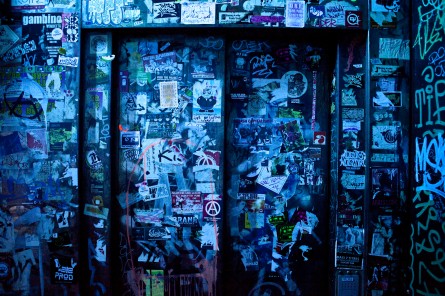
Elevator

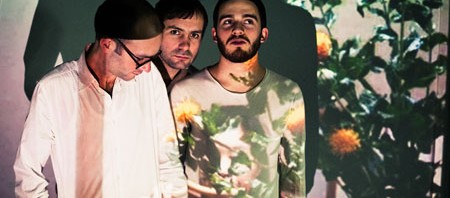
For the second time our group, Startsladd, sent in an application for a club gig at the Mapping Festival in Geneva. Just like last year we were out in the last minute. Our hopes to get a slot were not high but we got a spot at the closing party. The festival took care of the logistics very well. They booked and paid for our tickets and put us in a nice hotel room. It was nothing like what we are used to. We arrived the last day of the festival and we went straight from the airport to watch the VJ Contest that was taking place at Zoo Usine. The contest was interesting because of how it was set up. It was split into four parts, all judged by a jury. The first part had taken place the day before our arrival. There were 16 contestants and eight of them had advanced to the next day.

UPDATE Video from the first day of the VJ contest.

The task for the quarter final was to use a small number of still images (approx. 20 including the Mapping Festival logotype) on which they had to base their material. They got the images at the end of day one, so many of them had probably worked the entire night. Half of them moved on to the semi final. They now got to use whatever material they wanted. But they had to draw a card, on which it said what kind of music they were going to perform to. There was reggae, funk, hip-hop and power metal. None of them genres that are closely related to visual performances. Out of these four VJ’s were now only M&Y and Indefinite VJ left. In the final they competed in a classical battle were the contestants had about 30 sec to perform before the turn went to the other side of the room. Then back again for another 30 sec, etc. After a 15 minute beer break and consulting between the jury, alone stood the winner and it was M&Y.

Video: ARES | M&Y | GRAFKUT

After the contest it was time for dinner at Zoo Usine. I was served a cup of coffee by the second dirtiest punker I’ve ever met (the dirtiest punker I’ve ever met didn’t know how to operate a coffee machine).

The video check worked like a charm. The club had a guy responsible for and only working with video. He was there for the entire night making sure that everything went on smoothly. The working space was huge. Startsladd alone had three computers that we hooked up to the Edirol V-440HD mixer. With it’s two buses connected to the video matrix and software written by Garagecube we could then decide and seamlessly mix what went out and to which one of the screens in the room. It was very simple and fun to work with, since this technology opened an extra door in our performance.
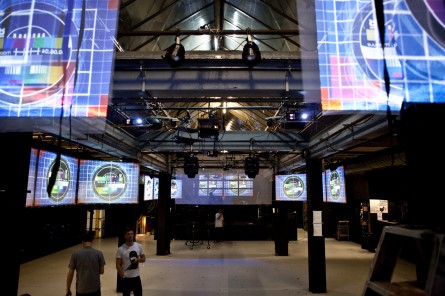
More screens

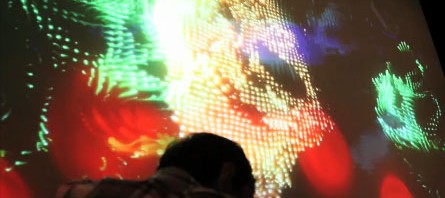
During the night there was six VJ’s/crews that performed, all together with their own DJ. Except for Dat Politics, who at their arrival told the organizers that they didn’t want to have a VJ during their performance. They brought their own DVD with prerecorded material. That caused some rearrangement of all the acts, since everyone had counted on using a VJ for this slot. After all it’s a festival for visual performers. Crews of the evening were: Jellyfish, Startsladd, KRMT, VNBC and M&Y. All put colors on the dance floor with their own very personal style. The funny thing was that out of five performances this night, four of them contained material with Mexican wrestling masks.

Video: Startsladd @ Mapping Festival 2010

I was very impressed by the Belgian VJ Jellyfish’s performance. He had a very nice mix of recorded footage and graphics. It was interesting to see how he had put it all together. Often with a character from movie, masked out and put on a solid light color, mixed with moving graphical elements. It was kind of a disappointment that the other crews didn’t take advantage of the fine technology that Zoo Usine offered. Startsladd was the only crew that really played around with the HD-mixer. The others sent their one and only output to all the screens.

Video: Jellyfish Demo reel

The party was great and the place was packed the entire night. In the backstage area a lot of good ideas came up and many new connections was made. At 4.30 AM we threw in the towel and went back to the hotel, the Mapping Festival 2010 was over. We woke up on Sunday looking forward to eating some good bacon at the hotel breakfast just to be informed that bacon had not been paid for by the festival. For a short while we hated them stingy bastards intensive. But then we got reminded of the free t-shirts we had been given. We returned to the hotel room and recorded some material against the frosted glass in the shower cabin. Then we packed our bags and left Geneva. The night had been a blast, it was just sad that we hadn’t been able to see more of the festival. I can recommend everyone who considers it, send in the application next year! Startsladd will.
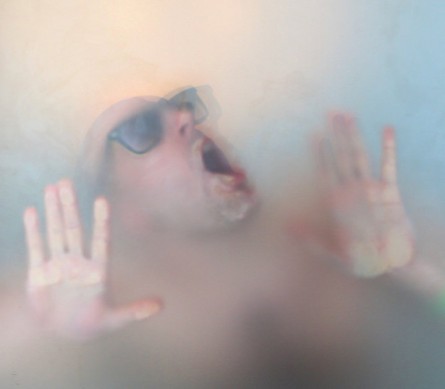
Froested glass

AntiVJ in Sweden

Norrköping Visualiseringscenter

AntiVJ, the kings of video mapping, will be presenting a new audiovisual piece directed by Romain Tardy at the Norrköping Visualiseringscenter this upcoming saturday (May 29th). The Vidiots will also feature something they call a “video sculpture”.

“Projecting immaterial information (data) on something very concrete and real (a building) is also an opportunity to think about the relationship between intangible and pratical work, statistics and factual, labour and its finality, which are all very current questions about our dematerializating world.”

Read all about the event on Facebbook.

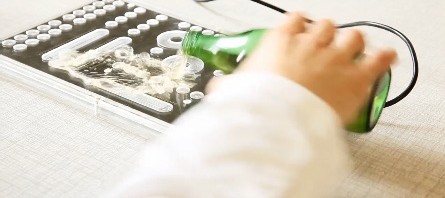
New beer proof Midi controller

I was chatting with Andreas Apelqvist from Starstladd who just came back from the Mapping Festival in Geneva. We had heard rumors previous to the festival about a new VJ geared Midi controller from Codanova that was supposed to have controls similar to the first iPod. This funny teaser movie premiered during the Mapping festival and was uploaded to Vimeo earlier today. Andreas says he heard further rumors that Codanova are planing to release the controller in a month, “but they’re French, so I don’t trust ’em”, Andreas added. I’ve contacted Codanova about this and they say that they will release it in September. No word on pricing yet.

It looks like it’s somewhere between a touch interface like the Lemur or iPad and a traditional controller with regular buttons, knobs and faders. The only similar product I can think of is Stanton’s SCS 3 system. The layout of the VMX Activ8 is made specifically for the Modul8 VJ software but I’m pretty sure that it will work with most VJ programs. I’m not sure if this controller is as tactile as I want it to be, but hey it’s beer proof god damn it and I’ll probably buy it, or as Andreas said, “you’d buy anything with a midi logo on it”.

Andreas will write about their Mapping Festival adventures within the next few days, stay tuned!

The Pixelache 2010 festival report

Pixelache 2010

I was invited to the Pixelache festival to hang out and network. For once I didn’t have to perform or give a speech, so I could indulge fully in the activities. I only went friday to sunday and got straight from the airport in to the Bar Camp session at the Keravan Taidemuseo located in one of Helsinki’s outer suburbs. For those who are not familiar with the term “Bar Camp” I could describe it as a user generated conference where the content is provided by the participants, anyone can post a subject to discuss. This went on the whole day and several interesting discussions went on parallel, so it was pretty hard to pick. I went between groups dealing with guerilla gardening, software presentations, audio visual experiments and open source technologies. The day ended with the opening of two exhibition at the Kerava museum, How to Build a Dishwasher and chmod x+ art and later a Pixelache network dinner in Helsinki.

There were a couple of things from the Bar Camp that I found extra interesting. One is the open source project Puredyne which is a GNU/Linux package for artists. It’s an operating system bundled with a load of open source software for artists and the whole system is bootable from a USB stick or a CD and will run on your Intel machine.

The second thing was the project Brainwave Music Lab where they were making music from alpha and beta brain waves. I’m not going to tell more just watch the video, it give me the chills, you know, in a good way.

The Saturday started with Breakfast Club III, a breakfast with a discussion about open source technology led by cyber feminist Nathalie Magnan. It got pretty interesting, with many different views. There were the extremists looking for the utopian open source society, there was Li from Shanghai who explained how Open Source was not relevant for young people in China at the moment since people don’t think software costs money and then of course the people complaining that they will become less productive with Open Source applications. For me personally, the more interesting discussion about Open Source technology was on the boat back to the hostel where I came to speak to Italian design students, Emanuele Bonetti and Loredana Bontempi from the Piet Zwart Institute in Rotterdam, who are in a program that runs only on open source software. They said that they couldn’t really find good replacements for the standard design applications but they had other applications that let them do other things and take their designs in new directions. That sounded very appealing to me and we immediately started bouncing more or less realistic ideas.

The Arduino + Fritzing workshop

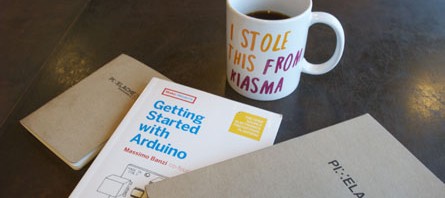
After lunch there was the Fritzing+Arduino workshop. Arduino is an open source prototyping platform that makes it easy for artists and designer types like you and me to create physical interaction devices. Fritzing is an application that let you document your electronic prototype and help you take it steps closer to production. I’ve been wanting to get in to the Arduino for a few years and this was the perfect time to get started. I bought the neat little starter kit from the Fritzing people that had an Arduino and some basic components.

http://vimeo.com/10497522

At night I went to see The Urban Projection Lab, that was an architectural video mapping on the front of the Finnish National Theater. The environment was a little bit to lit up for my taste which made the projections a bit washed out. We actually walked past in without seeing it and had to circle the block. If I understand it correctly we saw a visualization of Helsinki’s energy consumption in form of bubbles going up the facade.

The night continued at IHME Party located at the Vanha Student House. The night started bad with some hipster DJ playing the a Finnish version of a Pippi Longstocking tune and drunken Finnish girls dancing awkwardly. BUT then came the Black Horse + VJ Sakke Soini performance that was AMAZING. It’s rare to see such good band + visuals combination and they got the lighting and smoke to blend in as well. The band and the VJ had never worked together before and it was the band’s first live performance ever. One of those magic moments.

I never got a chance to speak to Sakke Soini that night but emailed him to ask some questions.

(TMT= The Midi Thief/Me, SS=Sakke Soini)

TMT: Your style with, what looks like old optical experiments or maybe just fx part out of old sci-fi movies, is that found footage or have you created it yourself, or some combination in between? And how do you work with your compositions while VJ-ing?

SS: Yeah, they are all my creations. I utilize the same techniques I use for my illustrations. I create clips that are easy mix together a sort of a continuum of each other. Therefore it is really easy for me to mix dynamically during the performances, create dynamic changes quickly and with the music.

TMT: What hardware and software is involved in your creation process as well as the performance?

SS: Mostly I create my graphics with Illustrator and After Effects. During the performance I use Resolume 2.4 running on my Macbook through Bootcamp and a MIDI controller.

TMT: Why are you using Resolume 2.4 in Windows and not Resolume Avenue in OSX?

SS: I tested Avenue a bit when it came out on my white Macbook, but I didn’t see any point upgrading. The program was a disappointment. And why fix something that isn’t broken. But I do very little post-processing during my live show anyways. I mainly just adjusting the colors.

TMT: Your visuals works extremely well together with this music (Black Horse) but what music do you normally VJ to? And how does the look and the tempo of your graphics work then?

SS: I basically have two vjing styles. The one you saw and the other one is more vector based. For the more uptempo i use the vector based stuff. The clubs i normally VJ for is more Electro/Disco/Dubstep oriented.

The second performance of the the night was Swedish Slagsmålsklubben and VJ Motorsaw aka Sune Petersen, an awesome Danish guy that I shared rooms with at the Hostel on Suomelinna. The extremely happy uptempo music of Slagsmålsklubben seemed to work really well with this crowd and so did the visuals. Sune had a project set up in VVVV that he based his whole performance on. It looks like vector lines but is really to slanted rectangles, one masking the other that he can tweak the shit out of with a Korg NanoKontrol. I think that one quality that I particularly liked was the possibility of changing the stroke weight. This might seem trivial but I actually can’t remember seeing it used that much. It’s really useful for interpreting nuances in the music.

The classic after party for those who didn’t want to go home or those who couldn’t get back to Suomelinna took part at a design agency. Slagsmålsklubben, Sune Petersen the Mal Au Pixel crew and others from the Pixelache network. All kinds of alcohol appeared auto-magically when some other alcohol ran out.

Don’t think I really managed to do anything productive the following Sunday. There were a few performances I would have liked to have seen but I missed them and then had to leave for the airport.

Share NYC

If you find your self in New York City, I would like to recommend you to go to Share. Every sunday evening they throw an event labeled as “open stage multimedia jam”. First and foremost it is a place where you can explore different expressions in a variety of art forms. It´s all about ongoing collaborative and performative processes and cultural exchange. A place to meet, discuss and exchange ideas. You are encouraged to bring your own equipment, plug into their system and improvise on other´s signal and perform live audio and video.

It takes place in an old can factory in Brooklyn at a venue called The Issue Project Room – their mission is well described under Mission on their site: “ISSUE Project Room provides an open and versatile environment where both established and emerging artists can conduct, exhibit and perform new and site-specific work according to their respective visions. Through an evolving collaboration with curators, artists and educators, ISSUE Project Room fosters a wide-range of artistic projects that challenge and expand conventional practices in art.”

A couple of details from Share.dj:

“Audio jam: Prepared and spontaneous music from eight plus simultaneous performers. This is the time and place to perform a piece of music you’ve written and hear it on a large sound system, improvise spontaneously with other participants, get feedback on your latest project or try out that new max patch/software setup. Bring your noise maker of choice and an XLR, quarter-inch or RCA cable to join.

Video jam: multi-user live video synthesis. Generating an immersive visual environment, in the SHARE tradition, in which multiple participants are able to jointly compose the video output. Try out and learn about new VJ wetware. As with the audio, walk-in sets are encouraged. Bring your clips or camera or laptop/amiga and VGA, S-Video, or RCA cables to join.”

The idea of doing something like this in Stockholm is very appealing to me! Get in contact if you feel the same vibe!

Datastorm and the 8-bit scene

I’ve been meaning to write about the 8-bit scene for quite some time and recently something happened that gave me a very good reason to get it done.

Ok, forget what I said about street cred.
Ok, forget what I wrote about street cred.

I have my roots back in the Amiga demo culture but saying that I was part of the scene would be to exaggerate. I was in a couple of demo groups but I didn’t really take part in any social events and my work was not spread to the rest of the world. I divided that part of my life to programming and breakdancing with the result of not being great at any of the two. It gained me enough street cred to avoid a beating and an understanding of programming that proved to be helpful later in life.

When Ilan Katin told me about the Datastorm party that was going on in Gothenburg parallel to Pixelvärk I got really excited. Datastorm is dedicated to the Commodore 64 and Amiga demo scenes. When we were done with the last Pixelvärk event and all the equipment was packed up, Ilan and I took a cab to an industrial area on Lindholmen in the outskirts of Gothenburg where the party was located. The party had already been going on for over 24 hours when we showed up just before midnight and they were pushing on for another 12.

We were greeted by a drunken, kind of aggressive looking Finn, shouting “AAAAMIGAAAA!”, like a battle cry, which was repeated by others throughout the venue. We came right in to the competition and demos were projected on a huge screen in the main room. These were the categories in the competition:

  • Amiga demo
    A combination of sound, graphics and programming for the Amiga.
  • C64 Demo
    A combination of sound, graphics and programming for the for the Commodore 64.
  • Amiga bootblock intro
    Kind of the same as the an Amiga Demo but the it has to fit on the bootblock of an Amiga floppy disk, which is 1024 bytes. So basically you have to create something really astonishing with very few lines of code and simple music and graphic to go with that.
  • C64 Graphics
    Graphics created on the Commodore 64.
  • Amiga ASCII
    Graphics created with letters using a monospaced font. See examples here.
  • Amiga music
    Music composed on the Amiga, usually using a sequencer called “tracker” deriving from the original Soundtracker software by Karsten Obarski.
  • C64 music
    Music composed on the C64 using sequencers like SDI, JCH, DMC and GoatTracker.

Some musicians on the C64 and the Amiga use private “homemade” sequencers that only a few selected people has access to. Some even program their music directly in Assembler code, which of course is nuts!

Otromatic, Ilan Katin & GOTO80

A “demo” is graphics animated to music. It’s not performed live like a VJ set but programmed to fit the music and all effects are rendered in real time, so it actually bares a lot of similarities to VJing. A demo group often consists of musicians, graphics people and programmers (“coders”) but often members hold many roles. A good demo should contain great music and graphics but it also need to be innovative and skillfully programmed often challenging the limits of the platform. These machines aren’t anywhere near the capabilities of today’s computers. A C64 came with 64 kilobytes of RAM. The Amiga 500 came with 512 Kb of RAM that could be expanded to 1 Mb (or 1024 Kb to be exact). A harddrive for the Amiga was really expensive and held like 20 Mb, if I remember it correctly. Music wise these both computers have interesting music chips. The SID chip of the C64 has a nice and very specific lo-fi feel to it while the Paula chip in the Amiga is not as specific since it can produce a much better quality in four channels and makes it possible to do decent sampling. During the party the classic C64/Amiga scenester Mahoney released a Mp3 player for the Commodore 64. I yelled “FINALLY!” It kind of sounds like crap (due to the lo-fi sound chip) but it’s funny as hell that someone took the time to do it.

otro-newd1otro-newd2otro-newd3otro-newd4
(Images by Otromatic, click the images to see them larger).

I met a couple of VJs at the party. The first one was the frenchman Julien Ducourthial a.k.a. Otromatic. He is still doing demos and artwork for the Amiga scene but he also VJs in the 8-bit style. He is part of the Up Rough Soundsystem that does various 8-bit audiovisual work.

I was curious about how Julien works so I took the opportunity to ask him a few questions (TMT= Me/The Midi Thief, OTR=Julien/Otromatic)

TMT: – Are you using the Amiga computer or emulators on PC/Mac/Linux when you work?

OTR: – Well I used to have an Amiga setup in the beginning, I used two Amigas when we were running gigs with the ParisHQ, an Edirol V4 mixer and using both exe files and Mnu software for animations but then I switched to Pikix vj tool on the handheld Gp2x when it came out and I’m still keeping this configuration, this is quite similar to mnu and amiga veejaying but with less heavy gear to travel with.

TMT: – When creating your artwork do you use Deluxe Paint or are you emulating the style in modern software like Photoshop?

OTR: – For video and animations I’m using Amiga titlers softwares mainly for dynamic 2d/3d animations and optimize them on the PC for palettes and file sizes purposes. For graphics I’m using Personal Paint and Brilliance on the Amiga and Pro Motion on PC.

TMT: – Is it important for you to use the original software / hardware to get  the right feel?

OTR: – Yes, it helps me getting it low-tech, and finding new approaches with those softwares today.

TMT: – I read that you felt a bit tired of the 8-bit scene for a while – how was that effecting the esthetics of your work?

OTR: – Yep, sometimes I think the community is very purist in staying 8-bit only and won’t open up to other fields (with exceptions of course). I hope it can go forward and drop some more experimental combinations! I’m more in to polymorphic releases,  just trying to adjust the mood and feel to what made the 8-bit aesthetic a cool and fun thing to enjoy!

TMT: – What do you have in store for your upcoming VJ sets?

OTR: – I took a break from VJing for a couple of years to work on graphics more than videos. I’m planning some more iconoclast vj approach, different graphic materials, breaks and glitches for my upcoming VJ sets, stay tuned!

(You can also download the file in it’s original Amiga format.)

I captured this slideshow by Otromatic at Datastorm. The music is made by swedish chip tune artist GOTO80 (Anders Carlsson) who is also in the Up Rough crew. The piece was made with an Amiga 1200 and was prepared a week before Datastorm but was finalized during the party. The piece is inspired by C64 Petscii & old school megademo graphics. The slideshow is of course also available for download in it’s original Amiga format.

I also met another VJ, Markus Hamburger a.k.a. Rudebox and Yonx (Rudebox on the music and VJ scenes, Yonx on the demo scene). He is currently about to get his master in science from Chalmers in Gothenburg, has a pretty tech approach to VJing and in his thesis work he has been doing some interactive video installation using Processing, Quartz Composer and VDMX in combination with Ableton Live. Markus is member of the international audiovisual crew Up Rough Soundsystem. As of a couple of days, Markus and the Up Rough Soundsystem are new members of the Swedish VJ Union.

[blip.tv ?posts_id=3162307&dest=-1]

There are some other people (not present at the Datastorm party) that are worth mentioning in relation to the 8-bit scene and VJing: Raquel Meyers is a name that keeps on being mentioned. She does a nice blend of techniques and I especially like the Polybius performance with GOTO80 (thanks to Ilan for showing me this!) that is based on an urban legend about an arcade game that drew people insane.

http://vimeo.com/8756750

Paris Treantafeles is another VJ who mainly uses hand held game devices when performing. He comes highly recommended, even the United Nations loves him.

Svenska Narkotika Polisföreningens c64 tidskrift

Last but not least, probably the funniest thing seen at the Datastorm party was the release “Svenska Narkotika Polisföreningens c64 tidskift nummer 2”, a C64 floppy magazine about narcotics allegedly published by the Swedish police force. A group of anonymous purists from the C64 scene (probably undercover police officers) have urged me not to publish any of the pages. You simply have to download it yourself and run it through a C64 emulator. But I tell you – it’s worth the trouble!

A report from Pixelvärk 2010

I’ve had a week to come down from all the stress of arranging a festival. Pixelvärk turned out really great due to a nice collaboration with Gorki Glaser-Müller, some contributing organizations and the power of our VJ community with the Startsladd boys in the front, doing a tremendous job. We also did a smart decision by working with the set designer Erika Weissenberg and two assistants Niklas Andersson and Jesper Nilsson all of them proving to be invaluable. I thought I’d break down the festival as brief as possible in this blog post. Ok, well you know me, it won’t be THAT brief…

The Gothenburg Film Festival’s opening party at Trädgårn’

We got off to a rough start by being two ours late to the venue due to some trouble checking out the rental car. We had rented one projector and brought two of our own but we had hired the rental company to hang all three of them. They only hung one (badly, attached with two loose screws) and refused to hang the two others since we were a bit late. Also, the film festival had made a late decision to wrap the room in white “photo paper” as they called when telling us on the phone two days ahead (destroying our original plans for the room). They made us believe that it was the kind of paper used as backdrops in photo studios which sounded ok at the moment. These proved to be A2 papers taped up on the wall by a very stressed producer. But we had two screens at our disposal so we ripped down half of the papers and got started hanging the projectors with the help of Gorki’s Magic Arms (both the product and Gorki’s own arms of flesh and bone). We were done about the time the doors opened but we weren’t supposed to get our VJs started until late, so we just got a logo running and went downstairs for drinks. Oh, and another drama that played out two days before the opening party was that the film festival totally misunderstood the need for music in the house-techno genres and had booked DJs playing everything from motion picture soundtracks to love ballades. We got that sorted out however and we’ve got Kid Sid and Jethro playing for us which was an excellent choice.

Daniel from Startsladd was so eager to get started that he opened 45 minutes early. Great to see that enthusiasm but I think he might have fired of a lot of his material those first 45 minutes. The last part of their set, the Startsladd boys had Kid Sid and Jethro and they fired of some new great material that they’ve had prepared for the Pixelvärk week.

When Bopa got in charge of the visuals she had to deal with Kid Sid who was really showing off behind the turntables and doing a lot of fast tempo changes. Bopa handled it very well even though her midi controller was broken. I guess that’s one of those moments when experience really comes in to play. Her visuals were really beautiful and together with her musicality really formed a great set. She was using a PC laptop running Resolume and Macbook Pro running Modul8, mixing the two in the Edirol V4.

Johan Holm from Vidiots finished of with their signature graphics based on glowing light effects but also surprising with some hand drawn content somewhere in the middle. Working the musical climaxes very well, Johan finished off strong. He had a little mishap touching our scaler/switcher unit causing the image to scale down a bit but that didn’t stop him at all. That unit came to cost us a bit more trouble later on and I think we should build a cage for next time or at least put it out of harms way.

In the large hall next to our room there were some VJing going on too. VJ Union member Hie from Visual Bandits were doing visuals for the controversial hip hop act Maskinen. I just got a short clip from it and my camera freaked out from VJ Hie’s frequent strobing during the chorus. I really liked the stalking rapist quality in the visuals for “Den som inte dansar” (chorus goes: “The one who doesn’t dance is a rapist!”).

The Bopa lecture

No sleep for Anna and the Pixelvärk crew. The lecture was held in the afternoon and we had a good turn out with people from different fields within art and design. Anna was showing her work and had a nice conversation going with the audience. One of the topics that came up was video loops for sale. Anna used to be involved with a project where they sold music with visuals. The discussion turned to video that is sold on sites like vjloops.com and whether that is good for the VJ community or not. Anna claimed that it’s good for all VJs since if more people (VJs and DJs) demands visuals, the clubs must invest in the proper equipment. This was talked about in the context of VJs creating their own content or buying video clips made by others.

A new week started and the Pixelvärk crew worked hard on promoting the rest of the Pixelvärk program and filling up the upcoming workshops.

The first Modul8 workshop

Andreas Apelqvist and Dan Nordgren from Startsladd held the first workshop in the basics of the VJ software Modul8. It was really fun to watch them going over the whole interface and what every little thing does. Even as an avid Modul8 user I picked up a few new things.

The Johan Södeberg lecture

The first and only lecture held on the Cinemix stage in the Gothenburg International Film Festival’s tent on Järntorget. The tent was actually a really good venue for lectures and you’re pretty much sure to have a big audience. Johan Söderberg, director, composer but maybe foremost known as one of Sweden’s best film editors. Johan was talking about the new education program in Audiovisual design that he is launching at the University of Dalarna as well as showing some of his work. The discussion really got going when people started asking him about where he got his video clips from and how the copyrights were handled. Söderberg pretty much divided it up in commercial work where big money is payed for all rights and non commercial projects where he simply “steals” as he puts it. As the the discussion got deeper the line between commercial and non commercial work got really fuzzy and Söderberg himself really couldn’t or wouldn’t draw a line. As some people in the audience seemed a bit skeptical one film maker thought that film makers should offer some of their archive material free of charge for people to experiment with.

Audiovisual Collaborations

In the afternoon Ilan Katin, our guest from Berlin, held a lecture in audiovisual collaborations. Showing some work from three very different artist collaborations he painted a picture of what could be done in this field. As a fourth example he showed Lance Blisters, one of his own collaborations and talked about how the project was structured and even opened up the project files. Ilan finished up by performing one piece live.
This was also the first lecture being offered as a live video cast. Unfortunately however, we didn’t get the sound working properly which was a real bummer.

The VJ jam

Trying to do three things on one day is very hard for a small team like ours so I’m very happy that we really pulled it off. The VJ jam took place at Nefertiti in collaboration with the club The Eye. A collaboration that we pulled out of the hat about a week before the festival since our other plans really didn’t work out. To add to the difficulties, all of the equipment could not be rigged at Nefertiti before the gig. It’s a jazz club and they have concerts earlier in the evening so they didn’t allow any equipment on stage. We hung the projectors the day before which was a pretty time consuming job due to a very low ceiling which complicated things. Once again Gorki’s Magic Arms saved the day (not his real arms though, since he had to leave town for a meeting this day). After the jazz club was done we only had about an hour to rig three screens, a video wall as well as the VJ table with mixer, splitter and all cables. This is when the greatness of the Swedish VJ Union came in to play. Everybody helped out causing us to magically finnish somewhat on time. Even our guest, Ilan Katin was dragged in to helping out. But I think he was kind of pleased doing it and experience the spirit of our little community.

Each VJ set was split up to about 30 minutes per VJ act. I had some technical difficulties with our equipment so the first 10-15 minutes were spent getting creative with the blue screen (a good point was made that we should have taken us the time to set the projector’s default screen to black). I was followed by Ilan, Lysbang, Fetish23, Morrsken and Startsladd who all had very nice and memorable sets. The decision to add the old school video wall was great. We got our name up there and everybody had a good time playing around with the computer dedicated to the video wall while not performing, dancing or having drinks.

I must also lift my hat to Sankt Göran and Cazuma, the club organizers and resident DJs as well as Trickski, the DJ act visiting from Berlin. They performed very well and the dance floor was packed 5 minutes after opening the doors. I wish that could happen in Stockholm…

The Morrsken lecture

Can’t say we had a massive turnout for this early saturday lecture. But Linnea really did a nice presentation (her first of her VJ work) and we had a good conversation going. This time we also got the live cast going so we had some additional viewers on-line and more people keeps on watching the saved video stream. Linnea was, among other things, talking about living in a small community with lack of good clubs and visuals as well as being a woman in the VJ-world, something she claimed didn’t really effect her that much.

The advanced Modul8 workshop

The last thing on the Pixelvärk program was the advanced Modul8 workshop held by Ilan Katin. Many of us were tired from the VJ jam the night before and only had a few hours sleep. This didn’t stop us from having a great workshop. Ilan’s methodical way of explaining and de-dramatize things made it really easy to understand. After showing how to make our VJing more effective and fun with midi controllers and giving more insight to the module system as well as creating your own modules, he got down to more advanced concepts such as multi screen projection with the TripleHead2Go device, video mapping and controlling lights with the DMX protocol. He really made it seem like piece of cake and it reminded me of when my design teacher once said “Aftereffects is nothing but Photoshop with a time line, nothing for you students to worry about”.

Pixelvärk will be back but I’m not sure where and when. The only thing I do know is that I need some time before I’m involved with a project like this again, so it won’t be next week. For those of you living in the Gothenburg area, keep on the lookout for Gorki’s project Pixel Lab. They will continue with lectures, workshops and lab sessions for people interested in all forms of VJing.

Here’s Ilan Katin’s view on the Pixelvärk festival.

Nils Berg Cinemascope

I was going to see this spectacle live at the Gothenburg Film Festival but spaced out (or time traveled as I call it) after having two beers(!) and missed it. Must be the age… Anyhow, the concept was so awesome that I went straight home to google it. Nils Berg Cinemascope is a band that plays along with their favorite Youtube clips of people playing instruments. “This is the smallest band with the biggest opportunities”, as they describe themselves on their home page. The band consists of Nils Berg (woodwinds/electronics), Josef Kallerdahl (bass), Christopher Cantillo (drums). And I’m supposed to give photographer Miki Anagrius credit for the still image.

I noticed that nobody is credited for mixing (or cueing) the videos. What’s up with that? It’s a pretty essential part of the performance. And maybe that part could be done a little bit better. But even if so, it’s a bit charming that they project on a bed sheet and that they probably are using a very simple (and unexact) way of trigging the video clips.

[Edit:] Nils Berg Cinemascope has now joined the Swedish VJ Union. It’s fun to get an audiovisual act that also is more a than v. Here is their profile page.