Archive for the ‘technology’ Category

The *spark + d-fuse mixer

September 15, 2009

tobyz_box

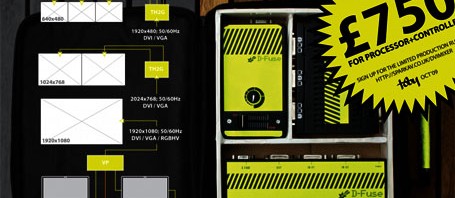
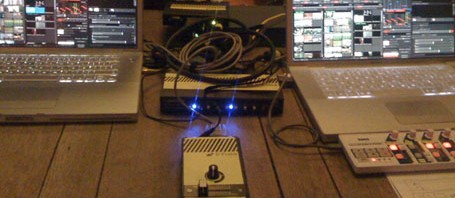
Sometimes prayers are heard. Remember the poll we did where we were asking “What do you think is a reasonable price for a modern video mixer that has the ability to mix VGA and send out an video that spans over 2 or more screens?”. A saint named Toby Harris has modified a conference kit and built a controller for it so that it’s possible to mix two VGA or DVI sources and output to a Matrox TripleHead2Go, which means that you can make a multiscreen projection and mix content from two computers. This has been possible to do earlier, but at a huge cost. Toby is negotiating with the manufacturer of the original box and he is planning to assemble enough orders to put it into production. His estimated price for the box is… ta-da… somewhere in the $1000-£1000 range. At the moment the manufacturer is busy with a trade show. We just have to tap our fingers impatiently until deal is sealed and Toby is ready for pre orders. Read more about the mixer on Toby’s website.

Results from the poll:

[poll id="8"]

Modul8 2.6 Beta

September 15, 2009

modul8_26_beta

So finally, the long awaited Modul8 version 2.6 is now out in beta. Along with some bug fixes and Snow Leopard compatibility there are some exciting new features: blend modes, sound analysis, dmx support, 4 video inputs and importing/exporting of midi & key maps.

The beta is available for registered users and the final version will be charged a €49 upgrade fee. Garagecube hasn’t charged for minor versions before and even if annoys me a little bit, I’d still buy the update in a heart beat. Even if I’m missing better OSC and Quartz Composer support in this release, this is a huge step in the right direction.

Read more about the new version at modul8.users.

Another way of selecting VJ software

August 31, 2009

What VJ software should I pick?

People often ask me what VJ application they should start with. I usually suggest that they should to go to softwarevj.com, find something for their platform, download a beta and play around for a bit. Let me present a slightly different solution:

Turn to the video hosting sites and look for groups and tags with the name of the major VJ softwares. You will get plenty of examples. The software that, in your opinion, has the best examples is the the software you want to pick. I still think it’s worth downloading a beta and see if you can handle it. And don’t forget to read the manual. Most of these softwares has very active user forums and FAQ’s that will answer most of your newbie questions. And don’t forget all video tutorials out there too!

Here’s some fast links to the video hosting sites:

Arkaos (Win/OSX) examples on Youtube
AV Mixer (Win/OSX) examples on Vimeo
Modul8 (OSX) examples on Vimeo
NuVJ (Win/OSX, both hardware & software) examples on Vimeo
Resolume (Win/OSX) examples on Vimeo
VDMX (OSX) examples on Vimeo

Modul8 and DMX

April 12, 2009

All Modul8 users are eagerly waiting for the next update that was promised for the first quarter of 2009. The Graragecube (the makers of Modul8) crew has said that they won’t bust out anything premature and rather wait until they have a stable release. However, I was emailing with a member of the crew who revealed that DMX support will be in the next release and you will need a ENTTEC usb to DMX interface to communicate with your DMX equipment. Modul8 will only support the ENTTEC drivers.

I’ll be continuing waiting eagerly… beachball2

A little bird also whispered in my ear that Garagecube is co-operating with the Austrian company VMS (Video Moving System) so that is going to be possible to control the mirrors of the Video Mirror Units straight from a Modul8 Module through DMX.

Resolume 3.0.0

March 14, 2009

Resolume is finally out of beta, version 3.0.0 was released on friday (the guerilla marketing scam in the Modul8 forum confirmed, see previous post). There has been a lot of bug fixes and small improvements. The biggest news seems to be that the audio analysis is back and the hardware accellerated codec we mentioned earlier. Still no support for Flash.

Read all the details here.

The battle of the codecs

March 13, 2009

There was an interesting discussion today regarding the Sheer video codec on the Modul8 forum where Dave from Vidvox (the creators of VDMX) and Bart from Resolume jumped in on the thread.

Sheer is a commercial codec that looks a bit better than Photo JPEG but results in slightly bigger files. Sheer also has support for alpha channel. The question is – is it worth $149?

Bart from Resolume was saying that the Sheer codec was not that great and accusing David from Vidvox of promoting the codec out of commercial reasons. David already denied any money being involved in his first post.

[Edit] This thread was started in 2005 so the initial posts are pretty old (like Daves and Barts comments), but the last posts with comparison of codecs is from a recent date. [/Edit]

In the same thread you could learn that you could swap the Animation codec for the more modern, faster, smaller PNG codec to get that nice alpha channel.

Read the whole thread here.

Some good news for Resolume users: Resolume has develeoped a new video codec called DXV toghter with The Pixel Addicts and UnitedVisualArtists. DXV is hardware accellerated and will decompress the frames using the video card’s GPU which is faster than using the computer’s CPU as conventional codecs does. This will result in the abillity to mix more video layers with higher resolution.

The codec is cross-platform and will work in all Quicktime enabled applications but the hardware accelleration will only be enabled in Resolume. And best of all, it’s for free. Read more and download the plugin on Resolumes home page.

SwarmCam

February 24, 2009

For for a few years, I’ve been a part of a research project that is driven by Arvid Engström at the Interactive Institute / Mobile  Life Centre, in Stockholm. I’ve written about this project here earlier.
Arvid has been researching around a VJ application using video streams from mobile phone cameras over the HSPA net (commonly known as ”Turbo 3G”). There can be many contributors (cameras) and one VJ that will decide what is being broadcasted. The VJ can give feedback to the people filming by showing that they are ”on air”, vibrate their phones for attention or send messages. The application goes under the name ”SwarmCam” for the time being.

Please enable Javascript and Flash to view this Blip.tv video.

The opensource software Movino is used to receive video over the HSPA-net and Max/MSP is used to mix the video sources and present the final output. In this case these softwares are run on a Macbook Pro. The software that must be present in the mobile phones to be able to connect to SwarmCam is written for Symbian. Unfortunately there are just few phones where user are allowed to install their own software.
The HSPA-net unfortunately has pretty big limits in upload speeds in it’s current state, which results in a pretty pixelated video quality. But with future cellphone nets we will be able to have much better video quality.

swarmcam_output

When I was testing the application for the first time with my DJ colleague, Henrik Berggren, the user interface wasn’t quite done yet. It was merely smacked together the night before. Even if this early version left a lot to wish for, one could clearly see it’s potential. The main functionality could be summed up like this:

  • Crossfader between source A/B and hard cuts between A/B.
  • Crossfader between B/C where C is pre made clips from the media bank.
  • Tempo control for clips from the media bank.
  • Media bank for pre made clips (that can be mixed with the live streams) and loops from the loop editor.
  • Image controls for source A/B.
  • The loop editor.

What impressed me the most of all these functions was the loop editor. The app will always buffer a few seconds of video. When you see something in a live stream that you want to record, just hit ”rec” and the recording will start a few seconds back in time (using the buffer). In that way you won’t miss the beginning of the action. The start and end of the recorded sequence can then be trimmed and saved as a loop in the media bank. This method of recording starting back in time is very smart and I haven’t seen it either in video or audio applications ever before.
On march 4 me and Henrik will demo SwarmCam when Mobile Life hosts an open house evening at the Interactive Institute. I’m hoping for a few additions like blend modes and MIDI-mapping that Arvid promised to build if there was enough time left.

Epileptic Strobe – a newmodule for Modul8

February 02, 2009

epileptic_strobe

Last weekend I threw together a strobe module for Modul8. Imagine combining a disco strobe with the flash function in Modul8 and adding some steroids. You can for example pick strobe color and the flicker frequency. What I like the most is the option to flicker the ”layer alpha” instead of color. This is probably the first Modul8 module that comes with a warning label.

You can read more about the module in Garagecube’s Modul8 forum. The module can be downloaded in the ”Online Library” in Modul8.

Multitouch for Mac/Win/Linux

January 15, 2009

The Beta

The Beta, or tbeta as it’s also called is a open source / cross platform program for video tracking and multi touch. It takes a video stream and sends out tracking and touch events. The program also communicate with software that handles the TUIO and OSC protocols.

Read more and download the software at NUI Group.

On NUI Groups main page you could also find a link to a nice DIY multi-touch screen guide.

Steim releases Junxion v4 for OSX

December 15, 2008

This is a program I’ve used a lot in the past to connect different game controllers to the computer so that I could control my VJ softwares. JunXion translates the game controler’s signals to MIDI. One of my favorite projects was running the video projections with a dance matte.

I haven’t used the software for quite a while, but today I got an email from Steim saying that JunXion has been updated to version 4 and that they have added support for a lot of techniques: MIDI, OSC, HID (joysticks, mice, touch screens), audio, Arduino and video tracking. It seems like a program that could kick OSCulator’s ass.

For me this is an early christmas gift. I’ll get back after trying the new functions. Read more about JunXion V4 here.