Posts Tagged ‘mapping’

Learn motion graphics, VJ-ing & video projection mapping

January 11, 2012

Digital Creative I – Motion Graphics, at Forsbergs School for Graphic Design and Advertising

(In Swedish only.) Denna kurs ingår i paketet Digital Creative I-II tillsammans med Interactive Design, men kan även läsas fristående. Kursen ger dig de nödvändiga grunderna för att kunna arbeta fram och utveckla idéer i rörlig grafik och video, anpassad för olika typer skärmar som dator, smartphone, storbildsprojektion, video mapping, live visuals/VJ-ing och audiovisual performance. Att arbeta med ett aktivt förhållande till ljud/musik är ett av fundamenten i kursen. Detta genom att inte bara klippa i takt till ljud/musik, utan även söka djupare relationer mellan syn- och hörselintryck – att jobba med vad som kallas intermodaliteter. Kursen är ett möte mellan estetik, teknik och teori med fokus på konstnärligt, kommunikativt och idéorienterat arbete.

Kursstart

Tisdag den 14 feb 2012 kl 18.00.

Kursfakta

Vi träffas en kväll i veckan, tisdagar mellan kl. 18.00-20.30, under 6 veckor. Du behöver också avsätta tid mellan träffarna.

Innehåll

Föreläsningar, workshops och eget arbete. Vi går igenom mjukvarorna After Effects, Modul8, MadMapper och hårdvaror som MIDI-controllers, converters, splitters samt ger köpråd.

Lärare

Kursen hålls av Joel Dittrich.

Ansökan

För att bli antagen till kursen ställs inga formella krav, dock måste du ha grundläggande datorvana och tillgång till en egen Macintosh-laptop med OS X 10.6 eller nyare. Antalet platser är begränsat och antagning sker i den ordning ansökningarna kommer in.

Inlämning

Lämna din ansökan digitalt här.

Avgift

Studieavgiften för kursen är 4.800 kr (6 kvällar). Moms tillkommer med 1.200 kr. När du antagits måste du bekräfta din plats genom att betala en anmälningsavgift på 500 kr, vilken dras från kursavgiften vid fakturering. Resterande avgift betalas innan kursstart. Kursen är inte studiemedelsberättigad.

Diplom

Alla elever erhåller diplom efter godkänd närvaro och arbetsinsats.

Frågor?

Kontakta Joel Dittrich via joel @ joeldittrich . se eller +46 739553053.

Syphon – a new revolutionary technology for OSX

November 08, 2010

I’ve been very exited about the new possibilities that are opening up with Syphon, the new revolutionary open source technology for Mac OSX by Anton Marini (Vade) and Tom Butterworth (Bangnoise). There has been a lot of talk about it lately but it was not until last week Syphon came out in Public Beta that everyone can download and try out for themselves.

So what does this wonderful thing do? Syphon allows applications to share frames – full frame rate video or stills – with one another in realtime with alpha channel. Syphon also utilizes hardware acceleration on the GPU allowing for HD video in 60 fps.

Syphon is both a framework for developers as well as some plugins. Plugins are provided for Quartz Composer, Max MSP/Jitter, FreeFrame GL and Unity 3D Pro. Through QC you can make Syphon work right now in VDMX plus CoGe and in Resolume through FreeFrame GL. The new upcoming VDMX 5 beta 8 there will be a true support for Syphon allowing for even more functionality.

Modul8 users has so far been out of luck since M8 doesn’t have full support for Quartz Composer nor support for FreeFrame GL. However, Garagecube (the makers of Modul8) has been working on an interesting video mapping software called MadMapper that lets you map video from any Syphon abled software. It would be really strange if GarageCube made a video mapping software that doesn’t work with Modul8. During the VJ Tourna festival in Budapest there was a presentation of the MadMapper where they used a special Syphon enabled version of Modul8 (also confirmed in this CDM article). So what does that mean? It means that we probably will see Syphon in the next Modul8 release but we don’t really know whenever that will happen.

To get an idea of what Syphon can do you should watch this video which demonstrates how to take a composition from VDMX and use it as a texture on a 3D object in Unity Pro, all happening in real time.

There has been quite some debate around Syphon and some people doesn’t seem to grasp the concept of having different softwares collaborating. Here are some things that have been written about Syphon lately:

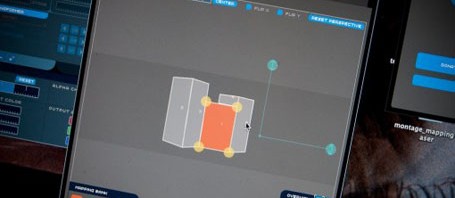
As a side note, the MadMapper, while only in it’s alpha version, looks great as a concept but as of now it doesn’t seem to have a very thought out user interface. I hope GarageCube would collaborate with Philippe Chaurand (Anome) from the Iduun collective who did a great job on the MapMapMap module.

New mapping module for Modul8

September 12, 2010

The French Iduun collective has finally released their eagerly awaited mapping module “MapMapMap” for Modul8. This module helps you with the perspective transformation, rotation of placements of layers as well as other useful functionality. Have a look at the documentation:

www.iduun.com/blog/2010/09/12/the-module-is-there-mapmapmap/

www.anomes.com/site/sticky/mapmapmap/

As a module maker myself, I must say that the Iduun collective makes some of the most interesting modules and they use techniques you don’t really know are possible to achieve within Modul8. If you’re in to Modul8, Python and module making be sure to look and learn from their code.

An interview with Aalto from AntiVJ

June 06, 2010
YouTube Preview Image

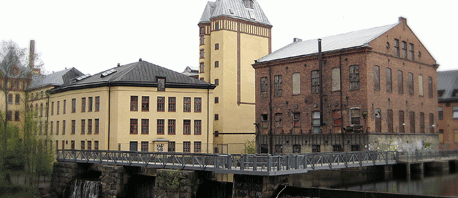
I got hold of Romain Tardy a.k.a. Aalto from AntiVJ and asked him a few questions about their latest mapping project at  Visualiseringscenter C in Norrköping, Sweden.

How much time did you spend on the mapping project in Norrköping and much time was spent working on site / off site?

From the very start of the discussions about this project to its final result, I think it was 3 months. We went to Norrköping to see the place in march, then we spent 2 days on site to do the mapping at the end of April, then we went back home to work on the content for 3 weeks, then back in Norrköping for 4 days to do the final tests and play the piece.
To precise things, I’d say we didn’t have any pre-produced content before we saw the site for the first time. We created everything from scratch, after we saw the place.

Could you break down your process in a few sentences, from idea to the final projection?

It’s always hard to describe precisely the work process, however, the building and its surroundings are always the starting point. We got inspired by the industrial past of the city, and, of course, by the new function of the building: the visualization center. How could we make these two elements meet each other?
We decided that I would be the director on this project, so I started to write a “scenario”, using the notion of labour as the central point of the story, taking both elements of its past (the notion of labour found in the textile industry, also visible in the nearby museum of work) and of its future – a visualization center – also questioning the relationship between intangible and practical work, statistics and factual, labour and its finality, which are all very current questions about our dematerializating world.
As we’re several people to work on the project, I drew a story-board so everyone can refer to the same document. As we work remotely, we meet every 2 days on Skype to see how things going.
Once all the content is done, I worked on the final editing – the actual piece the public sees.

What software do you use while creating and projecting your video mappings?

For this project, Simon Geilfus from our team created a new software so we can use some audio-reactive content based on vector graphics we designed. This software was used in the 1st part of the show. In addition, we used more traditional tools like After Effects, Illustrator, Cinema 4D.

What projectors are you using, how many and what hardware are you using to distribute the video signals to the projectors?

For this project, we used 2 Barco XLM HD30, that are 30K lumens projectors, outputting up to 2K resolution images. We didn’t use 2K resolution, but 1080p FullHD. For playback, we used Dataton’s Watchout hard/software, that is the easiest way to synchronize several projectors and have a smooth playback at such resolution.
The projectors can differ depending on the project. In Norrköping, the projectors were quite far from the building (on the other side of the river) so we needed pretty big ones. For closer projections/smaller buildings, 12 to 20k lumens projectors can be bright enough (also depending on the surroundings, public lights etc.)

Ok, this tech thing is going overboard, but what computers are you using?

Haha, this one’s going too far :D
For production and rendering in After Effects, Illustrator, C4D etc., we use Mac Pro’s (I you really wanna go geek, mine is a 4-core Nehalem with 8go RAM). By the way, Adobe CS5 is a must, working in 64bit on Mac Pro stations – it really improves rendering time and workflow in a general way using the total amount of RAM.
For Simon’s software, a Dual-Core DELL laptop was good enough (geek bonus: a PC running OSX…)

With your setup for video mapping – is it possible to mix content live (VJ-ing) or does everything need to be rendered and synchronized with the music in advance?

With the Watchout system, it’s possible to use live feeds from an external source. To do so, the Watchout must have the optional HD-SDI card installed, so it can take any input.
That said, I’ve never used it, and and I guess it’s a pretty big setup just for VJing. There’s an alpha version of a “mapping” module for Modul8 (made by some French guys as well) that would probably do the job too.

AntiVJ in Sweden

May 25, 2010

Norrköping Visualiseringscenter

AntiVJ, the kings of video mapping, will be presenting a new audiovisual piece directed by Romain Tardy at the Norrköping Visualiseringscenter this upcoming saturday (May 29th). The Vidiots will also feature something they call a “video sculpture”.

“Projecting immaterial information (data) on something very concrete and real (a building) is also an opportunity to think about the relationship between intangible and pratical work, statistics and factual, labour and its finality, which are all very current questions about our dematerializating world.”

Read all about the event on Facebbook.

The Pixelache 2010 festival report

April 03, 2010

Pixelache 2010

I was invited to the Pixelache festival to hang out and network. For once I didn’t have to perform or give a speech, so I could indulge fully in the activities. I only went friday to sunday and got straight from the airport in to the Bar Camp session at the Keravan Taidemuseo located in one of Helsinki’s outer suburbs. For those who are not familiar with the term “Bar Camp” I could describe it as a user generated conference where the content is provided by the participants, anyone can post a subject to discuss. This went on the whole day and several interesting discussions went on parallel, so it was pretty hard to pick. I went between groups dealing with guerilla gardening, software presentations, audio visual experiments and open source technologies. The day ended with the opening of two exhibition at the Kerava museum, How to Build a Dishwasher and chmod x+ art and later a Pixelache network dinner in Helsinki.

There were a couple of things from the Bar Camp that I found extra interesting. One is the open source project Puredyne which is a GNU/Linux package for artists. It’s an operating system bundled with a load of open source software for artists and the whole system is bootable from a USB stick or a CD and will run on your Intel machine.

The second thing was the project Brainwave Music Lab where they were making music from alpha and beta brain waves. I’m not going to tell more just watch the video, it give me the chills, you know, in a good way.

YouTube Preview Image

The Saturday started with Breakfast Club III, a breakfast with a discussion about open source technology led by cyber feminist Nathalie Magnan. It got pretty interesting, with many different views. There were the extremists looking for the utopian open source society, there was Li from Shanghai who explained how Open Source was not relevant for young people in China at the moment since people don’t think software costs money and then of course the people complaining that they will become less productive with Open Source applications. For me personally, the more interesting discussion about Open Source technology was on the boat back to the hostel where I came to speak to Italian design students, Emanuele Bonetti and Loredana Bontempi from the Piet Zwart Institute in Rotterdam, who are in a program that runs only on open source software. They said that they couldn’t really find good replacements for the standard design applications but they had other applications that let them do other things and take their designs in new directions. That sounded very appealing to me and we immediately started bouncing more or less realistic ideas.

The Arduino + Fritzing workshop

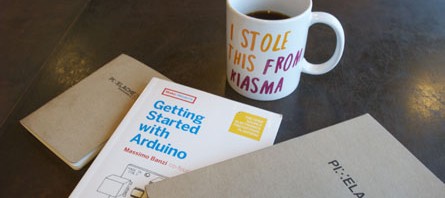
After lunch there was the Fritzing+Arduino workshop. Arduino is an open source prototyping platform that makes it easy for artists and designer types like you and me to create physical interaction devices. Fritzing is an application that let you document your electronic prototype and help you take it steps closer to production. I’ve been wanting to get in to the Arduino for a few years and this was the perfect time to get started. I bought the neat little starter kit from the Fritzing people that had an Arduino and some basic components.

At night I went to see The Urban Projection Lab, that was an architectural video mapping on the front of the Finnish National Theater. The environment was a little bit to lit up for my taste which made the projections a bit washed out. We actually walked past in without seeing it and had to circle the block. If I understand it correctly we saw a visualization of Helsinki’s energy consumption in form of bubbles going up the facade.

The night continued at IHME Party located at the Vanha Student House. The night started bad with some hipster DJ playing the a Finnish version of a Pippi Longstocking tune and drunken Finnish girls dancing awkwardly. BUT then came the Black Horse + VJ Sakke Soini performance that was AMAZING. It’s rare to see such good band + visuals combination and they got the lighting and smoke to blend in as well. The band and the VJ had never worked together before and it was the band’s first live performance ever. One of those magic moments.

I never got a chance to speak to Sakke Soini that night but emailed him to ask some questions.

(TMT= The Midi Thief/Me, SS=Sakke Soini)

TMT: Your style with, what looks like old optical experiments or maybe just fx part out of old sci-fi movies, is that found footage or have you created it yourself, or some combination in between? And how do you work with your compositions while VJ-ing?

SS: Yeah, they are all my creations. I utilize the same techniques I use for my illustrations. I create clips that are easy mix together a sort of a continuum of each other. Therefore it is really easy for me to mix dynamically during the performances, create dynamic changes quickly and with the music.

TMT: What hardware and software is involved in your creation process as well as the performance?

SS: Mostly I create my graphics with Illustrator and After Effects. During the performance I use Resolume 2.4 running on my Macbook through Bootcamp and a MIDI controller.

TMT: Why are you using Resolume 2.4 in Windows and not Resolume Avenue in OSX?

SS: I tested Avenue a bit when it came out on my white Macbook, but I didn’t see any point upgrading. The program was a disappointment. And why fix something that isn’t broken. But I do very little post-processing during my live show anyways. I mainly just adjusting the colors.

TMT: Your visuals works extremely well together with this music (Black Horse) but what music do you normally VJ to? And how does the look and the tempo of your graphics work then?

SS: I basically have two vjing styles. The one you saw and the other one is more vector based. For the more uptempo i use the vector based stuff. The clubs i normally VJ for is more Electro/Disco/Dubstep oriented.

The second performance of the the night was Swedish Slagsmålsklubben and VJ Motorsaw aka Sune Petersen, an awesome Danish guy that I shared rooms with at the Hostel on Suomelinna. The extremely happy uptempo music of Slagsmålsklubben seemed to work really well with this crowd and so did the visuals. Sune had a project set up in VVVV that he based his whole performance on. It looks like vector lines but is really to slanted rectangles, one masking the other that he can tweak the shit out of with a Korg NanoKontrol. I think that one quality that I particularly liked was the possibility of changing the stroke weight. This might seem trivial but I actually can’t remember seeing it used that much. It’s really useful for interpreting nuances in the music.

The classic after party for those who didn’t want to go home or those who couldn’t get back to Suomelinna took part at a design agency. Slagsmålsklubben, Sune Petersen the Mal Au Pixel crew and others from the Pixelache network. All kinds of alcohol appeared auto-magically when some other alcohol ran out.

Don’t think I really managed to do anything productive the following Sunday. There were a few performances I would have liked to have seen but I missed them and then had to leave for the airport.